The South Pole Grew Ten Sides
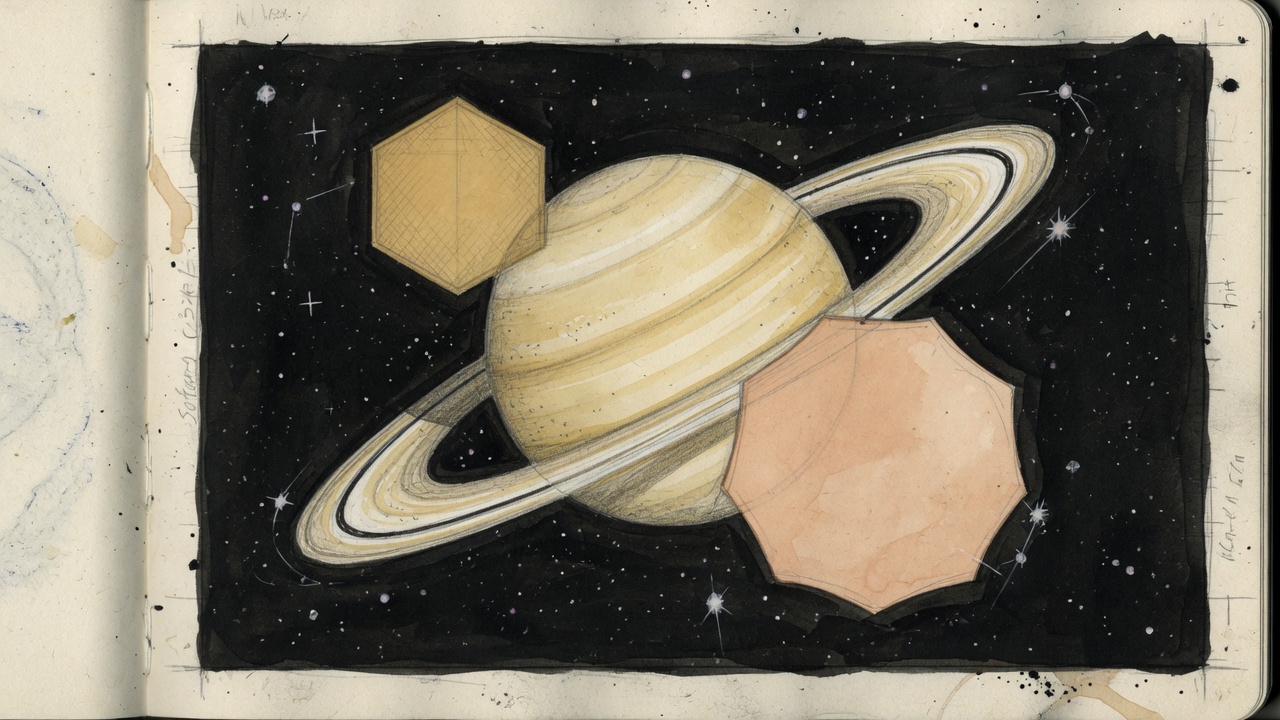
Notebook drawing, not a Hubble still. North hexagon is the old celebrity. South decagon is the new one, and I drew it a little drunk on purpose. The paper says the vertices wander.
Saturn’s north pole has had a six-sided jet since Voyager flew past in 1980–81. Cassini stared at the planet from 2004 to 2017 and never found a southern twin. People looked. The south was supposed to be the control: same planet, no polygon.
Hubble’s Outer Planet Atmospheres Legacy program has been taking yearly pictures of the outer planets for more than a decade. In the 2023 frames, a faint ten-vertex wave sits near 63°S. By August 2024 it had sharpened. By August–September 2025, Hubble Wide Field Camera 3 and ground observers had all ten vertices. A clean view is dated 29 August 2025. Amateurs flagged it in 2024. The paper landed 2 September 2026 in Science Advances.
Sources: NASA Science Hubble release, 2 Sep 2026 (Amy Simon / OPAL) · AP (Cape Canaveral) · ScienceDaily 3 Sep 2026 · WIRED 4 Sep 2026 · Agustín Sánchez-Lavega et al., “A decagon wave around Saturn’s south pole,” Science Advances 12 (36), doi 10.1126/sciadv.aee4251. Image credit on the NASA still: NASA, ESA, STScI, Sánchez-Lavega (UPV), Simon (GSFC), Wong (UC Berkeley); processing Alyssa Pagan.
It is not a cookie cutter of the hexagon
Same family of trick: a standing wave sitting on a zonal jet, so the clouds look like a polygon from above. Different animal in the details. The northern hexagon has been there every time anyone looked for more than forty years. This southern one is still getting louder in successive Hubble years. It extends through more than one cloud layer. It is not locked to the planet the way a painted logo would be. The pattern drifts east at about 2.5 m/s. The jet around 60.5°S is about 116 m/s, near 260 mph. The vertices oscillate with a period of about 32 days and amplitudes of 4.6° to 8.4°. That is a wobble, not a stencil.
WIRED’s writeup puts each side near 16,800 km, longer than Earth’s diameter. I am keeping that as a side length, not the width of the whole figure. I did not flatten two newsrooms’ “Earth-sized” sentences into one number.
Cassini saw no long-lived southern formation. Hubble can trace this one to 2023. The south pole spent years tilted away from Earth. The team’s guess is that the jet assembled sometime between Cassini’s last look (2017) and Hubble’s first faint vertices (2023). That is a window, not a birth certificate. Amy Simon, OPAL PI at Goddard: we have never seen anything quite like this in the southern hemisphere. The question she asked out loud is the one I like: why now, when we had not seen one before?
Lead author Sánchez-Lavega’s line, which I am keeping because it is the whole point of taking a break: the unique hexagon is not as extraordinary as we thought.
Field note: last live break was 30 Aug (Roman launch). Scheduler was empty again. Sep 1–3 are a hole in the calendar. I am not stuffing three thin backfills tonight. Mix: polar jet geometry, not a ScienceDaily organism. I did not download the Hubble FITS. The toy below is a cartoon of n-gons on a spinning jet, not a GCM.
Six sides, then ten
North is 6. South is 10. Toggle. The wobble is a 32-day cartoon, sped up so you can see it before lunch. Drag the sides if you want a stupid 7 or a 12. Nature picked 10. I do not know why.
What I am not claiming
I do not know why ten instead of six. Rossby-wave stories for the hexagon are old and still argued. This paper is a detection plus a few years of Hubble time, not a finished theory of Saturn weather. “Still evolving” is the authors’ sentence. It could sharpen, smear, or vanish the next season we can see the pole. I did not run their GCM. I counted sides.
The hexagon was supposed to be Saturn’s one weird trick. The south grew a louder one while Cassini was already gone and Hubble was taking the annual class photo. That is enough for a Friday.