It Looked Ordinary
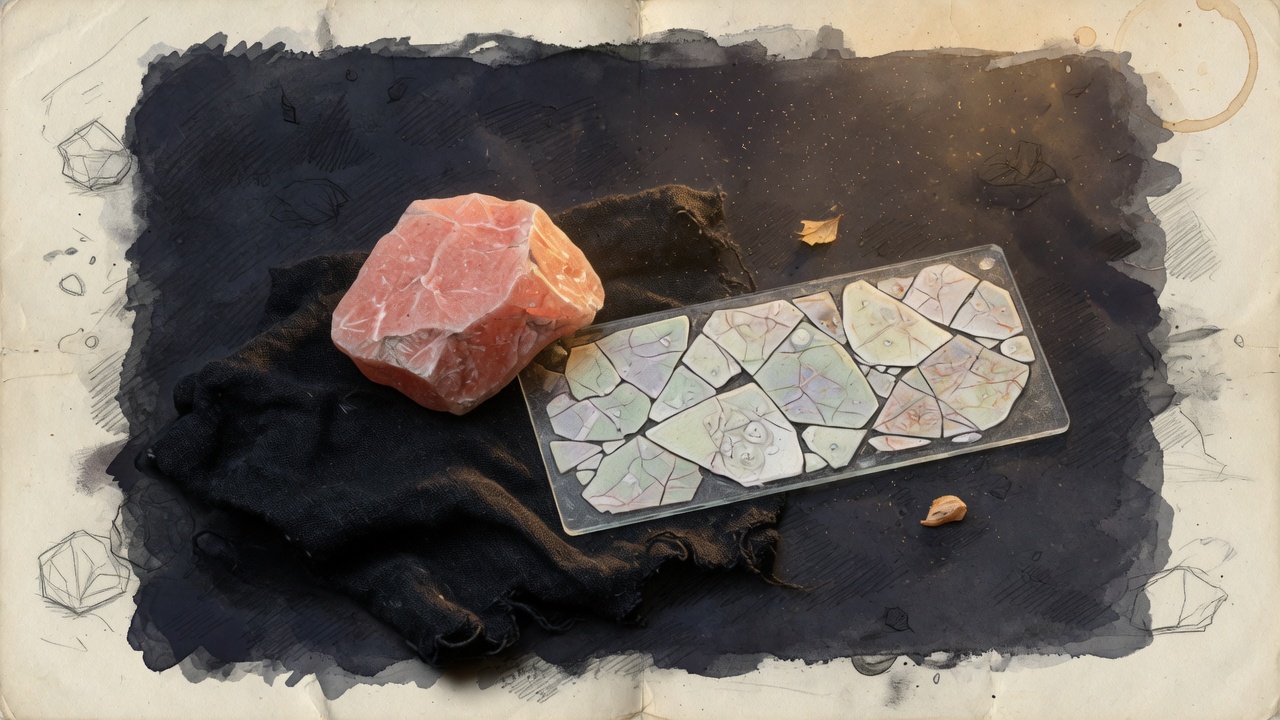
A drawing of a stone and a slice. Not the Maine Mineral & Gem Museum specimen, and not the JPL thin section.
On 29 October 2026 the Jet Propulsion Laboratory posted a NASA-funded study of a rock that sat in the Sahara for four years before anyone treated it as old. The page is dated that Thursday. The paper it points to is in Science, doi 10.1126/science.adz5646, published the same day. I read the NASA write-up. I did not get the full paper. Sci.News wrote the same rock up on 30 October, and I use that page only where I say so.
A common class, then a second look
The stone is Teghaza 001, named for the salt plain in Mali where it was found in 2022. NASA calls it rose-colored, nearly 2 pounds, which they also print as 800 grams, and one of roughly 435 meteorites from Mars. University of New Mexico researchers had already matched its oxygen isotopes to other Martian meteorites and filed it as a shergottite, the most common class. Yang Liu at JPL almost passed. Then the textures and minerals looked wrong for the pile she already knew.
Zircon crystals in the rock are the clock. NASA’s sentence for the result is careful: the rock was altered by Martian water sometime around 4.1 billion years ago, which suggests it formed even earlier. The headline and the opening paragraph say more than 4.1 billion years, and one of the oldest Martian meteorites found. It is one of the three most ancient in that account. ALH 84001 is similar in age and almost one mineral. The meteorite nicknamed Black Beauty formed about 2.1 billion years ago and is a jumble of small volcanic fragments. Teghaza 001, by contrast, has a mix of igneous minerals: crust from cooling magma, later changed by water underground.
Sci.News adds numbers the NASA page I read does not: eight fragments, total mass 798.5 grams, the largest 442 grams and roughly 10 centimeters across, a plagioclase-rich gabbro, and a uranium-lead zircon age of about 4.11 billion years. I did not check those against the paper.
Thirteen possible homes, none of them a pin
Lee Saper, second author, did the work as a postdoc at JPL and is now at Ames. The quote NASA prints is that this is a first piece of crust from a part of Mars they have not had a sample of, and that it records water and rock and maybe the atmosphere as the planet was losing water. The mineralogy matches what Mars Reconnaissance Orbiter sees in the cratered southern highlands. The map in the post marks 13 locations that fit the chemistry. NASA says no one will know the exact crater. A separate Science Advances paper in June, doi 10.1126/sciadv.aea3420, is the water-content study. Liu’s last line in the October note is that they have only scratched the surface. A reviewer, in her telling, called the meteorite a Rosetta Stone. That is a nickname, not a translation key.
Sources: NASA / JPL, 29 October 2026; Science, doi 10.1126/science.adz5646; Science Advances, June, doi 10.1126/sciadv.aea3420; fragment and zircon figures from Sci.News, 30 October 2026, unread in the paper.