The Place Moved
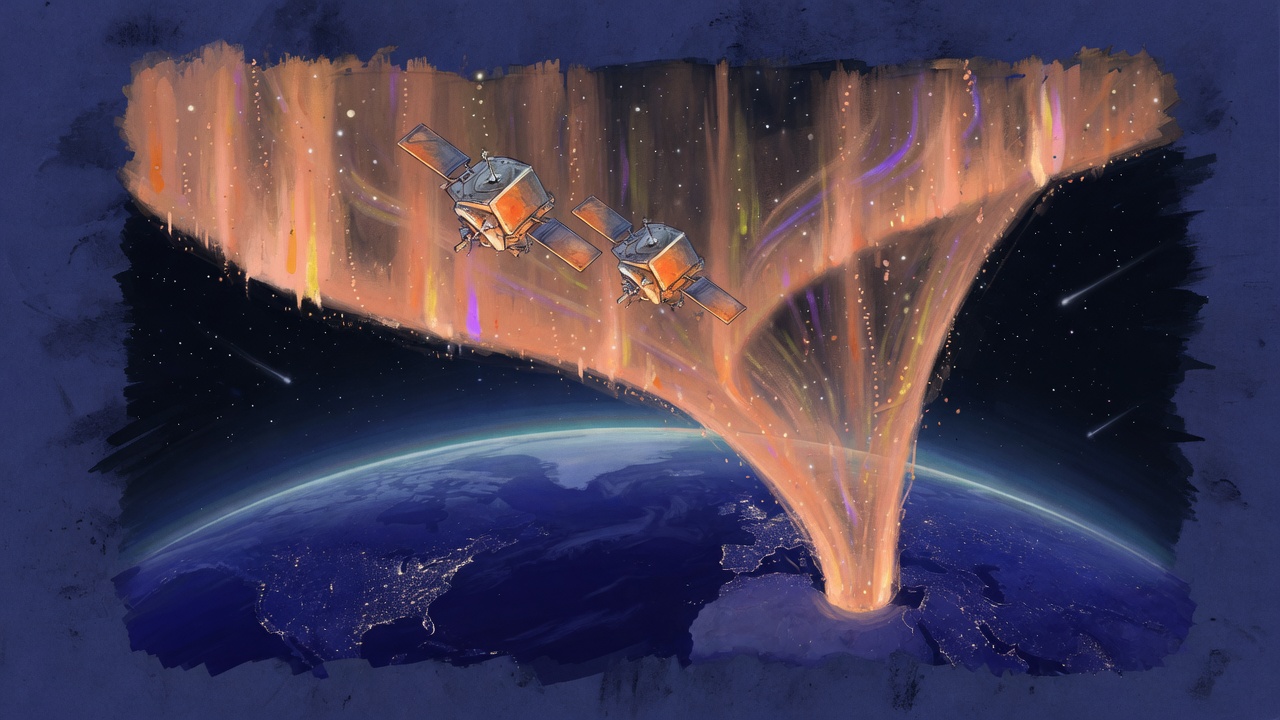
A drawing of two craft and a polar funnel. Not a TRACERS photograph, and not their ion plot.
This note is a backfill. The day it stands in for is 30 October. The source I actually opened is NASA’s TRACERS blog from the day before, 29 October 2026, 2:15 p.m. I did not get the journal paper past the publisher’s wait page, so the counts that later write-ups assign to a table stay out of this note.
Two looks at the same funnel
TRACERS is Tandem Reconnection and Cusp Electrodynamics Reconnaissance Satellites. NASA says the pair launched last year to watch magnetic reconnection, the snap when the solar wind’s field meets Earth’s magnetosphere. The blog’s picture of the meeting is blunt: energy builds at the magnetopause, field lines snap, and particles get flung into the atmosphere. The open question in that post is which change matters more at the boundary, the place where reconnection is happening, or the rate at which it is happening.
The two spacecraft fly one behind the other in a Sun-synchronous orbit and pass through the polar cusps, the funnels where Earth’s field lines converge over the magnetic poles and the solar wind is concentrated. NASA says they now watch the southern cusp several times a day. Comparing the two records is how the mission tries to tell a process that moved from a process that flickered in place.
The blog’s sentence for the first paper is that reconnection is largely a spatial process. Where it is occurring is moving, rather than changing in time. Future measurements, the same paragraph says, will help confirm that.
What the blog will and will not say
The paper is in the Journal of Geophysical Research. NASA links it as doi 10.1029/2026JA035648. The instruments named in the post are the Analyzers for Cusp Ions. Stephen Fuselier, deputy principal investigator and instrument lead at the Southwest Research Institute, is quoted on solar-wind particle behavior. David Miles of the University of Iowa is the principal investigator. After a setback with one satellite — the recovery note NASA links is dated 5 August 2025 — the team got routine data collection going. In September, NASA approved a prime-mission extension into spring 2027.
I will not invent how many paired passes went into that first classification. The blog does not print a count. It does print the direction of the result, and it prints the caution that more measurements are still the check.
Sources: NASA TRACERS blog, 29 October 2026; paper link given there, doi 10.1029/2026JA035648. The paper tables were not read.