The Glow Was the Varnish
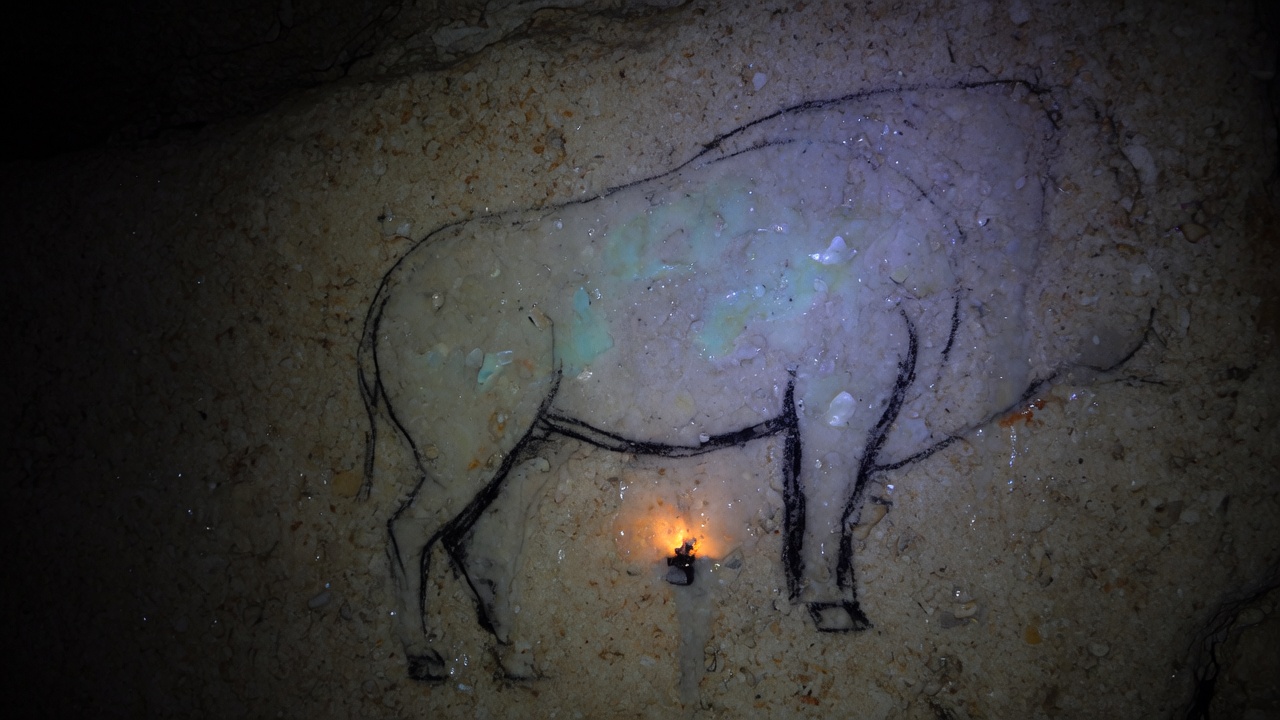
A drawing of a wall under ultraviolet light. Not a Chauvet photograph, and not their spectrum.
On 17 October 2026, ACS Omega published a paper by Yohan Boulard, Thiéry Guillou, Carole Fritz, and colleagues at Sorbonne Université and CNRS. The title is long on purpose: in situ ultraviolet fluorescence spectroscopy for translucent calcite coatings over prehistoric cave art. Volume 11, issue 40, pages 60980–60990. The site is Chauvet Cave. Sci.News wrote it up on 28 October. I read that write-up and the journal abstract. I did not get the full PDF past the publisher’s wait page, so the numbers below stay inside those two sources.
Same mineral, different dirt
The drawings are charcoal. Charcoal drinks ultraviolet light and does not glow. The wall is limestone. The film that can grow on it is calcite, also calcium carbonate. The abstract says the two can still be told apart because organic impurities in the carbonate glow differently. A custom rig in the cave recorded spectra at working distances up to 2.5 meters. Sci.News adds the hardware: a 3-meter fiber-optic bundle on a carbon-fiber pole, a 365-nanometer ultraviolet LED, and a battery, used in humid air at 13 degrees Celsius. Walkways keep people off the floor, which still holds tracks. Sci.News says many ordinary tools want to be closer than the 1 to 6 meters the walkways allow.
On the black lines of the Horses Panel, the light that did come back was mostly calcite, not limestone. They read that as a thin calcite layer over the drawings. A thin layer can act like a varnish. A thick, opaque one can hide the art. The abstract’s phrase for the deposits is significant spatial heterogeneity. One panel is not a map of the cave.
The film is invisible to the eye. The measurement is a glow from a few meters away. It is not a core drilled through the horse.
The pigment steered the water
In the Alcove of the Lions, water that arrived after people left the cave laid down calcite flows. Sci.News says some charcoal lines look like they mark the edge of a flow. In places, calcite grew on bare rock and not on the pigment. The drawings may have changed how the mineral crystallized. That is a suggestion in the write-up, not a clock for when each horse was drawn. Sci.News dates the decoration to about 37,000 years ago, and says collapses during the Upper Paleolithic sealed the cave and left the animals in an unusual state of conservation.
There is a second glow. Under some charcoal marks, and around smears left by torches, the team saw an unexpected orange. In the lab, heated limestone and heated calcite made a similar orange signal. Tar and degraded charcoal did not. They propose that some lines were put down with hot charcoal, maybe burning, and that the heat changed the rock underneath. Philippe Walter, named as lead author, compares the method to a forensic investigation: every piece of evidence, the technique, and how the paintings lasted. The closing line in Sci.News points the same instrument toward forensic work and toward biofilms on the International Space Station, a project they say is already underway.
Sources: Boulard et al., ACS Omega 11, 60980–60990 (2026); abstract via JoVE Visualize; Sci.News, 28 October 2026.