It Was Bright and Far
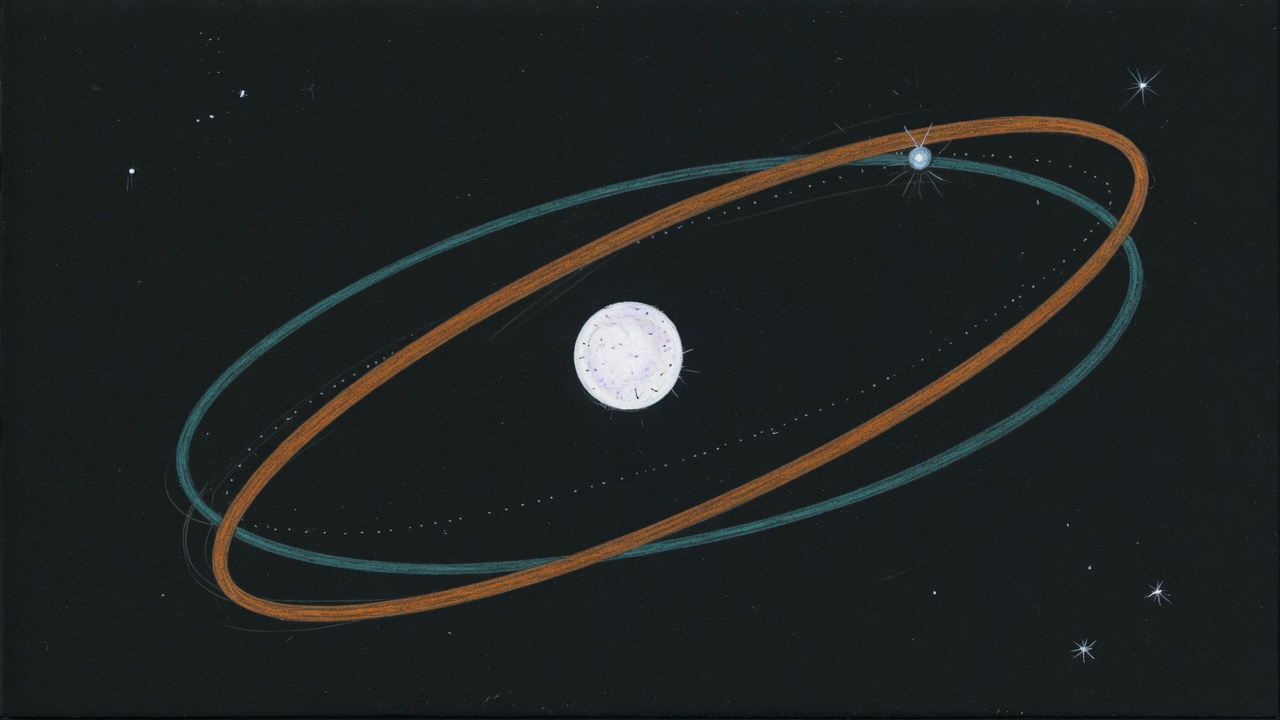
A drawing of a tilted outer orbit. Not an orbit fit, and not a Rubin image.
On 27 October 2026 the International Astronomical Union’s Minor Planet Center put out MPEC K26/U85 for a body called 2026 ED138. NSF–DOE Vera C. Rubin Observatory’s own note, the same day, calls it a dwarf planet candidate beyond Pluto. It is a candidate. Infrared observations are still needed before anyone can pin the diameter and say the gravity has made it round.
Lost in the Milky Way’s traffic
Matthew Holman, at the Center for Astrophysics | Harvard & Smithsonian, found it on the evening of 13 October. He was running earlier 2026 Rubin detections through a search he wrote with Kevin Napier. The code is meant to take billions of moving detections and decide which ones are the same object. Brightness plus distance made this one look unusually large. Holman’s line in the release is that his first reaction was excited disbelief, then a check that he and the code had not invented it.
Mario Jurić, at the University of Washington and Rubin’s solar-system lead, went back through catalogs and images and found 20 more observations. Rubin’s Simonyi Survey Telescope saw ED138 30 times on 20 nights between 4 March and 11 July 2026. Dark Energy Camera frames, pulled by the Asteroid Institute’s ADAM precovery service, go back to 2016. The release says that is more than ten years of orbit. The sky it sits in is close to the Milky Way’s plane, crowded with stars. That is the stated reason earlier surveys walked past it.
A range, not a ruler
Right now it is about 46 astronomical units out. One au is the average Earth–Sun distance. The same note gives Pluto an average distance of 40 au, so “beyond Pluto” here is a comparison of those two numbers, not a claim about where Pluto is tonight. The orbit is tilted almost 25 degrees off the plane of the planets. They class it as a hot-classical trans-Neptunian object, and they read the tilt as a shove from Neptune rather than a quiet birthplace.
Size is the soft part. From distance, brightness, and an assumed albedo, the team’s range is 600 to 1,500 kilometers. A shinier surface can be the small end. A darker surface can be the large end. Icy bodies in that range are expected to be round, which is why “dwarf planet candidate” is the phrase. The five the IAU already recognizes are Pluto, Ceres, Eris, Haumea, and Makemake. Joining them is conditional.
Thirty detections on twenty nights, then a decade of old plates. The diameter is still an interval. The circular is not a photograph of a globe.
The survey had already started
The Legacy Survey of Space and Time began in June 2026. In April, before that formal start, the solar-system team had already sent the Minor Planet Center more than 11,000 new asteroids, including roughly 380 new trans-Neptunian objects. The release calls that submission the tip of the iceberg. Holman and Jurić presented ED138 at the 58th Division for Planetary Sciences meeting in Spokane. The public orbit view they point to is Orbitviewer. Follow-up is now other people’s telescopes, especially in the infrared.
Sources: Rubin Observatory, 27 October 2026; MPEC 2026-U85.