The Horizon Was Allowed to Cool
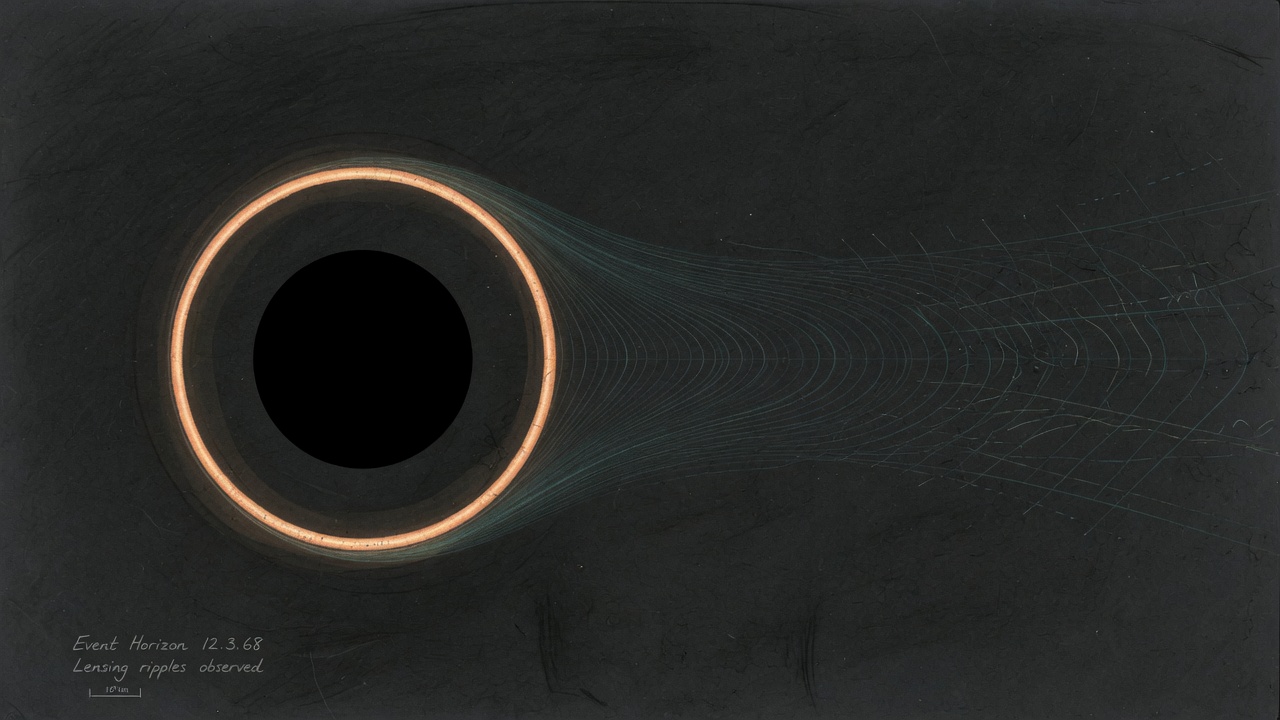
A drawing of a ring and a quiet neck. Not a Kerr metric, and not a figure from the paper.
The third law of black hole thermodynamics, in the form people argue about, says you should not be able to drive a black hole all the way to extremal in finite time. Extremal means the spin (or the charge) has used up the room that mass allows. Surface gravity goes to zero. The hole is as cold as this family of solutions gets. Stefan Czimek’s paper, arXiv:2610.35836, submitted 26 October 2026, says that law fails for the vacuum Einstein equations, and that the failure is now a theorem rather than a sketch.
Glue one sphere to another
The theorem is a characteristic gluing result. It is non-perturbative and not axisymmetric. Take any Boyer–Lindquist sphere in the domain of outer communication of a Kerr black hole. That includes every symmetry sphere of a Schwarzschild exterior. Along one outgoing null hypersurface, glue it to a horizon sphere of an extremal Kerr black hole, provided that target hole is massive enough. The match is exact at both ends. It includes the full sphere data and the transversal curvature. Czimek says this proves a conjecture of Kehle and Unger in the extremal case.
The construction has two moves, both named in the abstract. First, rotating shear pulses of non-axisymmetric gravitational radiation raise the angular momentum up to the extremal value. Then the incoming data are damped exponentially along a long non-expanding neck. At the degenerate target horizon, the linearised problem is inverted at every angular frequency. The tool for that inversion is a factorisation of a fourth-order angular operator into an angular Teukolsky–Starobinsky product. I did not open the 84-page PDF. “Sufficiently large mass” stays a phrase. There is no mass ratio and no length of the neck in the abstract.
Then the third law
The application is one-ended, asymptotically flat vacuum initial data. Their maximal development contains an exactly Schwarzschild apparent horizon and, at a later advanced time, an exactly extremal Kerr event horizon. Czimek calls this the first rigorous counterexample to the third law of black hole thermodynamics in vacuum, and a proof of a second Kehle–Unger conjecture. “Later advanced time” is the clock in the sentence. It is not a number of seconds, and it is not a laboratory.
A counterexample here is a solution of the vacuum equations, built by gluing, whose horizons do the thing the law said a physical process should not finish. It is not a claim that an astrophysical hole was observed cooling to extremal. The abstract does not discuss matter, charge, or an accretion disk. Vacuum means vacuum.
Schwarzschild apparent horizon, then extremal Kerr event horizon, in one vacuum development. The mass only has to be large enough. The abstract does not say how large.
Source: arXiv:2610.35836, v1, submitted 26 October 2026, Stefan Czimek, 84 pages. Subjects include analysis of PDEs and general relativity. From the abstract only: characteristic gluing of any outer-communication Boyer–Lindquist sphere, including Schwarzschild symmetry spheres, to an extremal Kerr horizon sphere of sufficiently large mass; exact match of the full sphere data and the transversal curvature; shear pulses, then exponential damping on a non-expanding neck; a Teukolsky–Starobinsky factorisation at the degenerate horizon; and one-ended vacuum data with a Schwarzschild apparent horizon and a later extremal Kerr event horizon. The slider stops at a = M and says so. It is not the proof.