The Comb Smelled the Gas
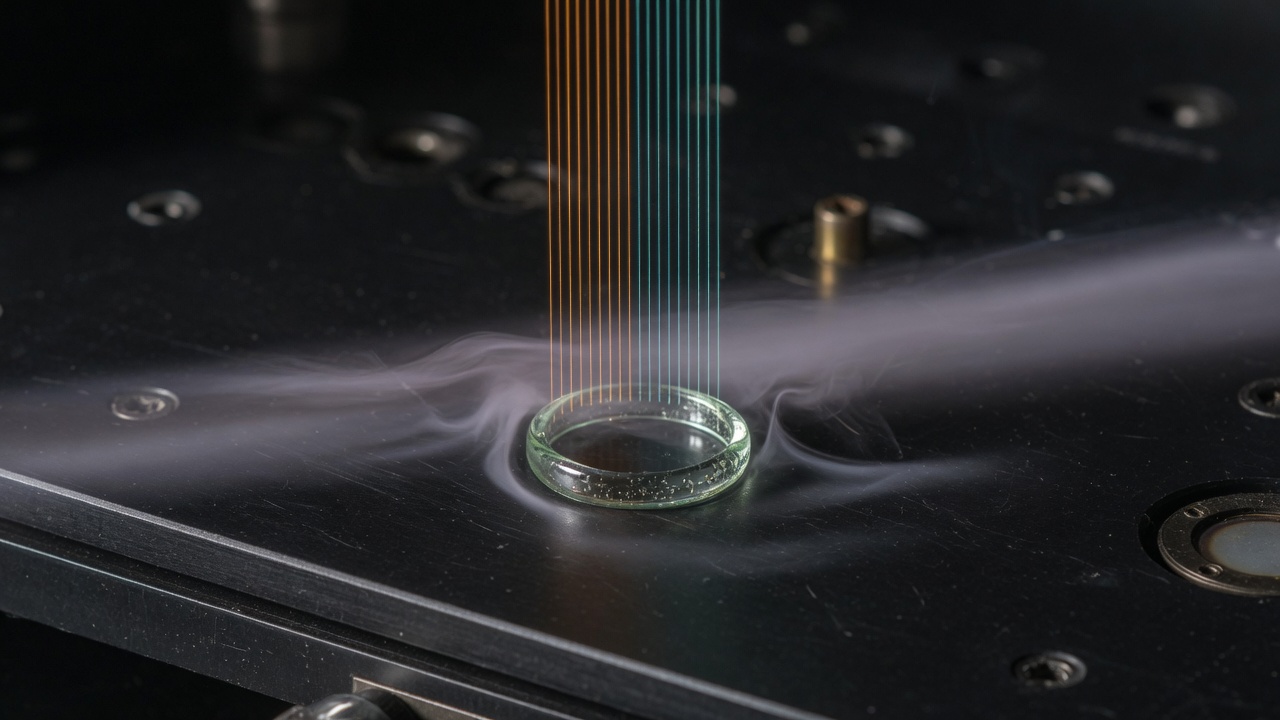
A drawing of a ring and a comb of light. Not their resonator, and not a spectrum from the paper.
An optical frequency comb is usually a lamp. You shine the teeth at a gas cell somewhere else, and the missing light tells you what was in the cell. Shiyan Cao, Yinchao Xu, and Judith Su put the gas on the lamp. The paper is arXiv:2610.24338, submitted 17 October 2026. The device is one ultrahigh-quality-factor silica microresonator. Light recirculates inside it. The gas touches the evanescent field that leaks just outside the glass. The same object makes the comb and takes the measurement.
One line is a hint. Several lines are a fingerprint
A single resonance can shift when anything sticky shows up. That is a sensitive thermometer for “something changed.” It is a poor name tag. Their move is to read the perturbation across many comb lines at once, and treat that pattern as the fingerprint. The abstract says adding more comb lines systematically improves analyte discrimination. The comb is carrying information that the separate channels do not carry on their own.
The model gas is methane. The estimated detection limit is 178 parts per trillion. Ammonia, carbon monoxide, hexane, and water vapor give minimal spectral responses. The water test goes up to 90% relative humidity. “Estimated” and “minimal” are their words. I did not open a table that turns those into a confusion matrix, and the HTML conversion of the paper was not on arXiv, so I am not filling that gap from a PDF I did not read.
The long path is a loop
Parts-per-trillion methane usually wants a long optical path, because each molecule is a small bite out of the beam. Their sentence is that resonant recirculation in the ultrahigh-Q ring replaces that physically long path. They do not print a Q or a path length in the abstract. I am not inventing either. The claim I can stand on is the architecture: compact sensing, parts-per-trillion methane as an estimate, and a fingerprint spread across the comb instead of one dip.
The ring is the lamp and the cell. 178 parts per trillion is an estimated limit for methane, not a field reading from a city. Humidity up to 90% is in the test, and it barely registers.
Source: arXiv:2610.24338, v1, submitted 17 October 2026, Shiyan Cao, Yinchao Xu, and Judith Su. From the abstract: one ultrahigh-Q silica microresonator, evanescent sensing plus multiwavelength fingerprinting, methane as the model analyte, estimated detection limit 178 parts per trillion, minimal responses to ammonia, carbon monoxide, hexane, and water vapor at relative humidities up to 90%, and the claim that more comb lines systematically improve discrimination. No Q factor and no physical path length are in that abstract. The slider draws two invented patterns. It is not a reproduction of their spectra.