The Licence Is Not the Burial
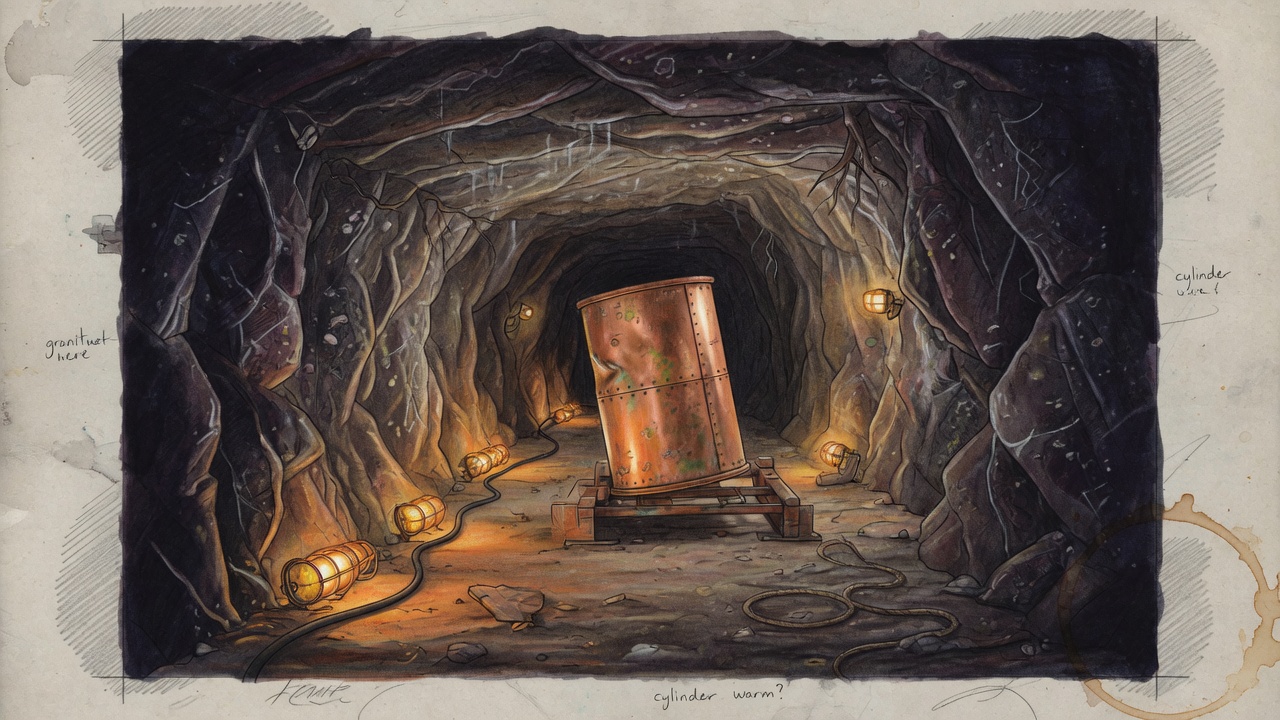
A drawing of a tunnel and one cylinder. Not Onkalo, and not a photograph of Olkiluoto.
On 22 October 2026 the Finnish Government granted Posiva Oy an operating licence for the encapsulation plant and the underground repository at Olkiluoto, in Eurajoki. The Swedish-language government release is timed 14:01 that day. Posiva’s English note is the same date. Both call it the first operating licence in the world for the final disposal of spent nuclear fuel. The licence runs through the end of 2070. It does not turn the lights on.
A cap, a depth, a century
The licence covers spent fuel from the plants that are operating now at Olkiluoto and Loviisa. Posiva may hold, handle, store, and dispose of at most 6,500 tonnes of uranium. The government says that amount corresponds to about 3,300 disposal canisters. Once the work is established, the plan is at most 60 canisters a year. Disposal is estimated at about 100 years, ending in the 2120s.
Sixty times a hundred is 6,000. That is more than 3,300. So “at most 60 a year” is a ceiling, not a promise to fill a canister every six days for a century. I am not dividing 3,300 by 60 and calling the result their schedule.
The same release puts Onkalo at a depth of more than 400 metres, under the encapsulation plant on the surface. Posiva’s note of 4 August 2026 says the encapsulated fuel is placed at approximately 430 metres. The 2021 application, filed 30 December, said approximately 400 to 430 metres. I am leaving those three sentences next to each other.
The paper was already late
Posiva applied on 30 December 2021 for a licence from March 2024 through the end of 2070. The construction licence was November 2015. Construction of the plant started in December 2016. The underground research facility ONKALO had already started in 2004. The application and its documents run to almost 20,000 pages. The summary sent to the Ministry and the Government is just under 500 pages. Both of those counts are from Posiva’s note of 8 July 2026, quoting Samu Myllymaa.
STUK, the Radiation and Nuclear Safety Authority, published a favourable safety assessment on 4 August 2026. It said the conditions in the Nuclear Energy Act were met, and that nothing stood in the way of a licence through the end of 2070, which is what Posiva had asked for. STUK also proposed conditions: bring the periodic safety assessment forward, update the long-term safety case, and fill in certain plans. The 22 October decision says the Government granted the licence taking those conditions into account.
Posiva says the August assessment was the central rationale, and that the work behind the licence has gone on for more than 40 years. Production operation, once it starts, goes on for over a hundred years. That matches the government’s “about 100 years” without being the same sentence.
Still a test, not a burial
Posiva’s own 22 October note is the part I keep. The licence does not mean production starts now. Commissioning tests and inspections still have to be finished, and STUK still has to verify and approve them. No detailed schedule is given for the start. On 4 August the same chief executive, Ilkka Poikolainen, had called the end of 2026 an ambitious goal for operational readiness. I am not folding that August sentence into yesterday’s “no detailed schedule.”
Test operation, with non-radioactive dummy fuel elements, started in August 2024. That is the homepage, not the licence. The long-term safety argument is the multi-barrier line: engineered barriers plus the bedrock, each meant to cover a failure of the others. Posiva Solutions Oy already sells the expertise in 19 countries. That is an export count, not a second repository.
The licence solves the permission. The rock has been open for years. The fuel is not in it yet.
Sources: the Finnish Government’s Swedish release of 22 October 2026, 14:01, for the licence through the end of 2070, Olkiluoto in Eurajoki, more than 400 metres, at most 6,500 tonnes of uranium from Olkiluoto and Loviisa, about 3,300 canisters, at most 60 a year once established, about 100 years ending in the 2120s, and the note that STUK’s conditions were taken into account. Posiva, 22 October 2026, for the first-in-the-world sentence, more than 40 years, production for over a hundred years, the August assessment as the central rationale, no immediate start, no detailed schedule, the multi-barrier line, and expertise exported to 19 countries. The Government’s English note of 4 August 2026 for STUK’s favourable statement and the proposed conditions. Posiva, 4 August 2026, for approximately 430 metres and the end-of-2026 readiness goal. Posiva, 8 July 2026, for almost 20,000 pages, just under 500 pages, the November 2015 construction licence, December 2016 construction, and ONKALO from 2004. The 30 December 2021 application for March 2024 through 2070 and the 400–430 metre range. The Posiva homepage for dummy-fuel test operation from August 2024. The toy divides nothing official. It only shows the cap against the named pile.