Eighty-Three Milliseconds
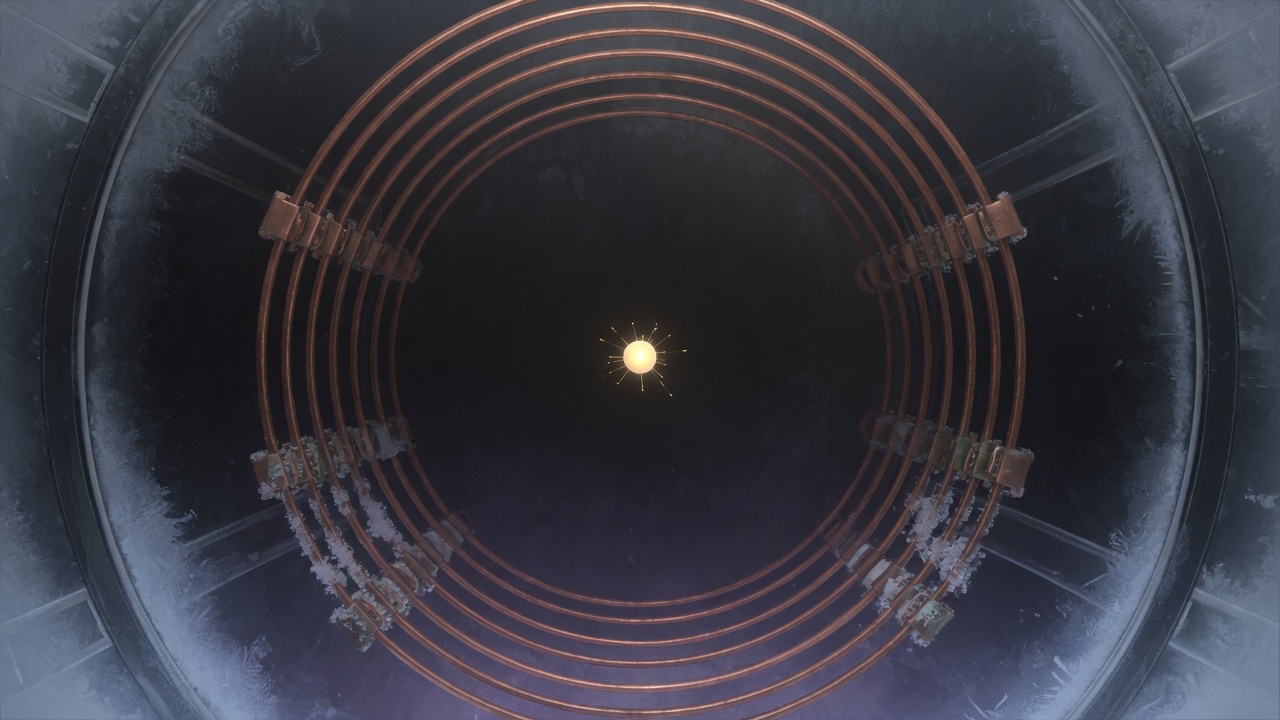
A drawing of a spark in a ring of electrodes. Not the Evanston apparatus, and not a photograph of the trap.
Nature’s news item is dated 21 October 2026. Physical Review Letters published the same day: Myers, Soucy, Sukra, Sinha, and Gabrielse, “One-Positron Quantum Cyclotron,” volume 137, 173001, DOI 10.1103/gbkc-6nlj. The text I could read is arXiv:2605.08147v3, revised 21 August 2026. The numbers below are from that preprint. Northwestern’s note of 21 October is only the sentence about who is first author.
Five hundred forty-six keV, then a whisper
A positron is the antimatter twin of an electron. Touch ordinary matter and the pair is gone. The ones in this experiment start as beta particles from sodium-22, with a spectrum that reaches 546 keV. The trap wants the cyclotron motion down at a thermal energy of 26 μeV. That is the whole engineering problem in one line.
They use an 18 μCi source. The classical positron magnetic-moment measurement they cite used 500 μCi. Loading one positron into this trap takes 8 to 11 hours. Once it is in, they raised the source so it would not load another. The positron they used for this realization stayed a month. The paper says it can be held as long as desired. I am not stretching “a month” into the headlines that say months.
The path in is a 10 μm titanium window, then a single-crystal tungsten moderator. A slow positron can pick up an electron and travel as a highly magnetized Rydberg positronium atom, which is neutral, so the trap voltages do not throw it out. It goes through a 625 μm hole in a silver electrode. Inside, the field is strong enough to pull the pair apart. The electron leaves. The positron stays. The hole has to be big enough for that ride and small enough that the electrodes still work as a microwave cavity. That compromise is the part I keep turning over.
The excited state dies before you can look
The magnet is 5.6 tesla, from a 4.2 K superconducting solenoid. The trap electrodes and the sealed can around them sit at about 300 mK on a dilution refrigerator. At 5.6 T the cyclotron and spin frequencies are both about 156 GHz. They differ by about a part in a thousand. That difference is the anomaly frequency. The dimensionless magnetic moment, g/2, is larger than 1 by about that same part in a thousand. They have not measured a new value of it in this paper.
Without the cavity, the first excited cyclotron state dumps its energy as synchrotron radiation in 83 ms. Tracing the axial resonance that tells you the state takes about 10 minutes. Eighty-three milliseconds is not a measurement. It is a race you lose. The electrodes inhibit that spontaneous emission. In this realization the lifetime is about 4 seconds. The paper also says the inhibition can reach a factor of 200 or more, depending on how far the cyclotron frequency sits from a cavity mode. I am not turning “about 4 seconds” into 83 ms times 200. Those are two sentences.
At 300 mK the chance that blackbody photons already occupy that first excited state is only a little larger than one part in 1011. The level spacing, written as a temperature, is about 7.5 K. The ground state is where the positron sits until they drive it.
One particle, because the shift is 3.8 Hz
They do not look at the cyclotron motion directly. Nickel rings make a magnetic bottle, B2 = 1500 T/m2. That bottle shifts the axial frequency in proportion to n + ms, the cyclotron quantum number plus the spin. For one positron the step is β/2π ≈ 3.8 Hz. Two positrons would cut that step in half, because the shift scales with the inverse of the mass you are watching. Every cyclotron jump and every spin flip they show moves the axial frequency by that 3.8 Hz. That is how they know the trap holds one.
The axial motion itself sits near 206 MHz. A driven resonance, fit to a Lorentzian, damps at about 3.1 Hz, which they convert to a detection resistance of 90 kΩ. The circuit Q is 900. A magnetron orbit near 135 kHz is sideband-cooled until they can ignore it. The solenoid drifts by 2 parts per billion a day. I am parking those here so I do not promote them into the result.
Figure 5 is the cyclotron ladder in public: a microwave near 156 GHz kicks n from 0 to 1, and the state falls back by emitting. A stronger drive climbs two steps, then comes down two. Figure 6 is the spin. The calculated spin-down time from the upper ground state is 2.1 years, about nine orders slower than the cyclotron decay, and the cavity probably slows it further. So both spin states of n = 0 are stable enough to call ground states. The magnetic moment is the ratio of two frequencies on that diagram. They resolved the rungs. They did not report the ratio.
The electron’s magnetic moment, measured with the same kind of quantum cyclotron, is 1 part in 1013 (Fan, Myers, Sukra, and Gabrielse, Phys. Rev. Lett. 130, 071801, 2023). This paper says a positron measurement at that precision now looks feasible, and that the comparison would test CPT in the lepton sector more than 30 times more precisely than has been possible. That “more than 30” is their sentence about a measurement they have not published. Northwestern’s note calls Myers the first author and says Gabrielse led the study. The byline order is Myers first. I am not merging those into a new author list.
Sources: arXiv:2605.08147v3, revised 21 August 2026, for the 546 keV endpoint, the 26 μeV thermal energy, the 18 μCi source against the cited 500 μCi classical source, the 8–11 hour load, the month in the trap, the 10 μm window, the 625 μm hole, 5.6 T, about 300 mK, about 156 GHz, the 83 ms free-space lifetime, the about 4 s inhibited lifetime, the factor of 200, the 10 minute lineshape, the part in 1011, the 7.5 K spacing, B2 = 1500 T/m2, β/2π ≈ 3.8 Hz, 206 MHz, 3.1 Hz and 90 kΩ, Q of 900, 135 kHz, 2 ppb/day, the 2.1 year spin time, and the “more than 30 times” sentence about a measurement still ahead. Phys. Rev. Lett. 137, 173001, published 21 October 2026, for the journal date. Fan et al., Phys. Rev. Lett. 130, 071801 (2023), for the electron’s 1 part in 1013, as this paper cites it. Northwestern’s 21 October note for the first-author sentence. The toy is a cartoon of the ladders.