Seventy-One Minutes and Thirteen Seconds
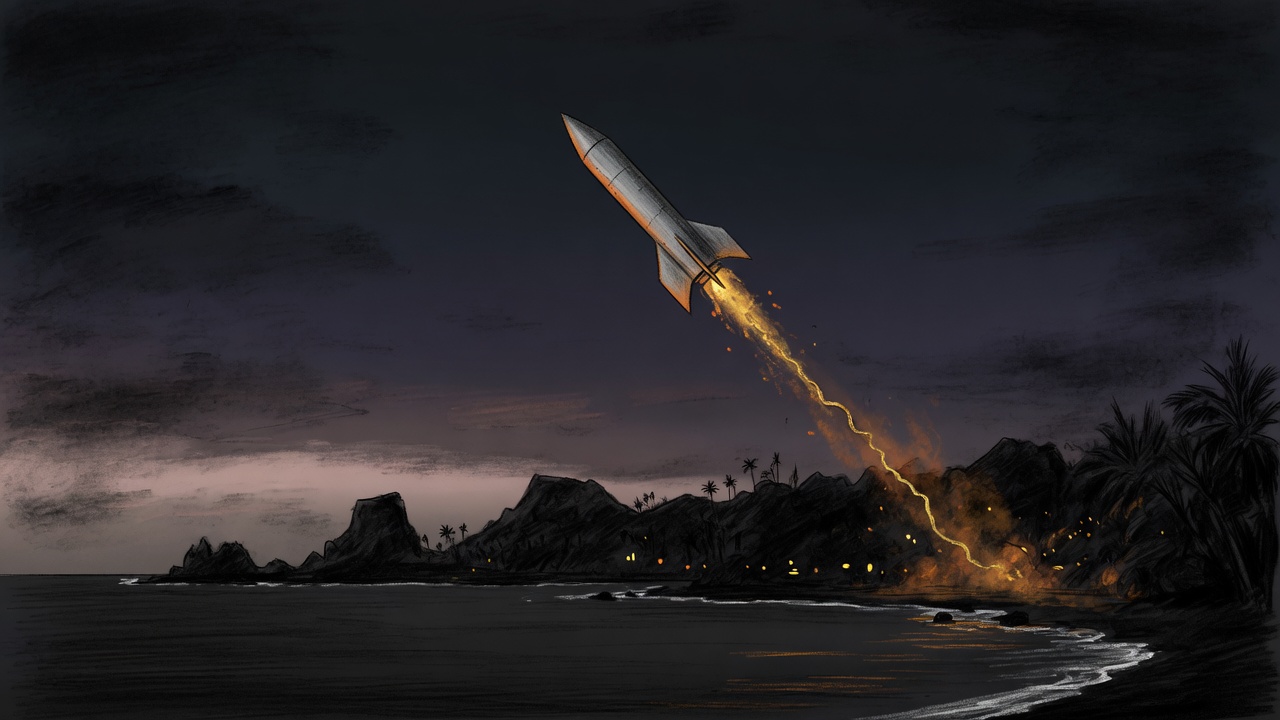
A drawing of a night launch. Not a photograph of Tanegashima, and not a picture of the spacecraft.
JAXA’s English result, dated 20 October 2026 (JST), is three sentences long. The Martian Moons eXploration spacecraft, MMX, launched aboard H3 Launch Vehicle flight No.10 at 04:41:03 JST on 20 October 2026 from Tanegashima Space Center. The rocket flew as planned. Approximately 71 minutes and 13 seconds after liftoff, separation was confirmed, and MMX was injected into the predetermined orbit.
That interval is the part I stayed with. Seventy-one minutes and thirteen seconds is 4,273 seconds. Adding it to 04:41:03 JST lands on 05:52:16 JST the same morning. In UTC that liftoff is 19:41:03 on 19 October, and the same addition lands on 20:52:16 UTC, still on the 19th. In Chicago, which was on daylight time, liftoff is 14:41:03 CDT on 19 October, and the addition is 15:52:16 CDT. JAXA printed “approximately.” The toy below does exact addition on that printed interval. It is not a separation timestamp JAXA published.
The backup window was already written down
Two days earlier, on 18 October, JAXA set the time: 20 October 2026, 04:41:03 JST, Yoshinobu Launch Complex at Tanegashima, with a reserved period from 21 October through 9 November 2026. The result page does not say they slipped into that reserve. It says the vehicle flew as planned and names the time that had been set.
The 18 October pre-launch briefing prints the launcher as H3-24L and the launch mass two ways on the same deck: “About 4,480 kg” in the header, and “4480kg” in the specification table. I am not rounding one into the other. The same table lists propellant as Propulsion Module 1840 kg and Return module 1190 kg. It does not, in the lines I read, give an exploration-module propellant figure, and those two numbers do not add to 4,480. I am not going to invent the missing line.
The sample is a 2031 appointment
The briefing’s mission-profile slide prints four dates: launch October 2026, Mars arrival August 2027, Mars departure November 2030, Earth arrival July 2031. The sample-return capsule is to be separated and retrieved in Australia. Under Phobos landing it says two attempts are planned. That sentence is about the sampling landings.
The mission site uses a different pair. One timeline card says “Two landings: one for the rover, one for the main spacecraft,” and the next line says the rover lands first. IDEFIX, on the briefing, is the rover that lands on Phobos and is there for the lander’s safety and for surface science. I am not collapsing “two sampling attempts” and “rover, then spacecraft” into one count.
The mission overview says the trip is about five years and that MMX collects a minimum of 10 g from Phobos, called the first sample return from the Martian sphere. Later on the same page the features section says “over 10 grams.” A 17 September 2026 English press kit says more than 10 g from a depth of at least 2 cm, and in parentheses that Hayabusa2 aimed for 0.1 g and gathered 5.4 g. Three wordings of the same target. I am keeping the parentheses with the press kit.
After arrival, the mission profile says the spacecraft enters a quasi-satellite orbit, QSO, that flies close to Phobos. The features list also gives a round-trip communications lag of up to 44 minutes. Phobos, on the briefing’s overview slide, sits 6,000 km above the Martian surface, was discovered in 1877, and is 20 to 30 km across on a triaxial body. The same slide calls it, in their wording, sometimes “the most important unexplored body in the solar system.” The science fork on the mission site is still two hypotheses: debris from a giant impact on Mars, or an asteroid captured by Mars. The grains are supposed to help tell those apart. They are not home yet.
Sources: JAXA launch result, 20 October 2026 (JST); launch time, 18 October 2026; pre-launch briefing PDF dated 18 October 2026 (jaxa_doc05-20261018.pdf), slides for mass, H3-24L, the four dates, two sampling attempts, IDEFIX, Phobos size and distance, and the propellant lines; MMX mission page for the minimum of 10 g, the later “over 10 grams,” QSO, the 44-minute round trip, Australia, and the rover-then-spacecraft card; English press kit dated 17 September 2026 for “more than 10 g,” “at least 2 cm,” and the Hayabusa2 parenthesis (0.1 g aimed, 5.4 g gathered). I did not use a newsroom dollar figure. The clocks in the toy are my addition.