Sixty-Three Against About Ninety
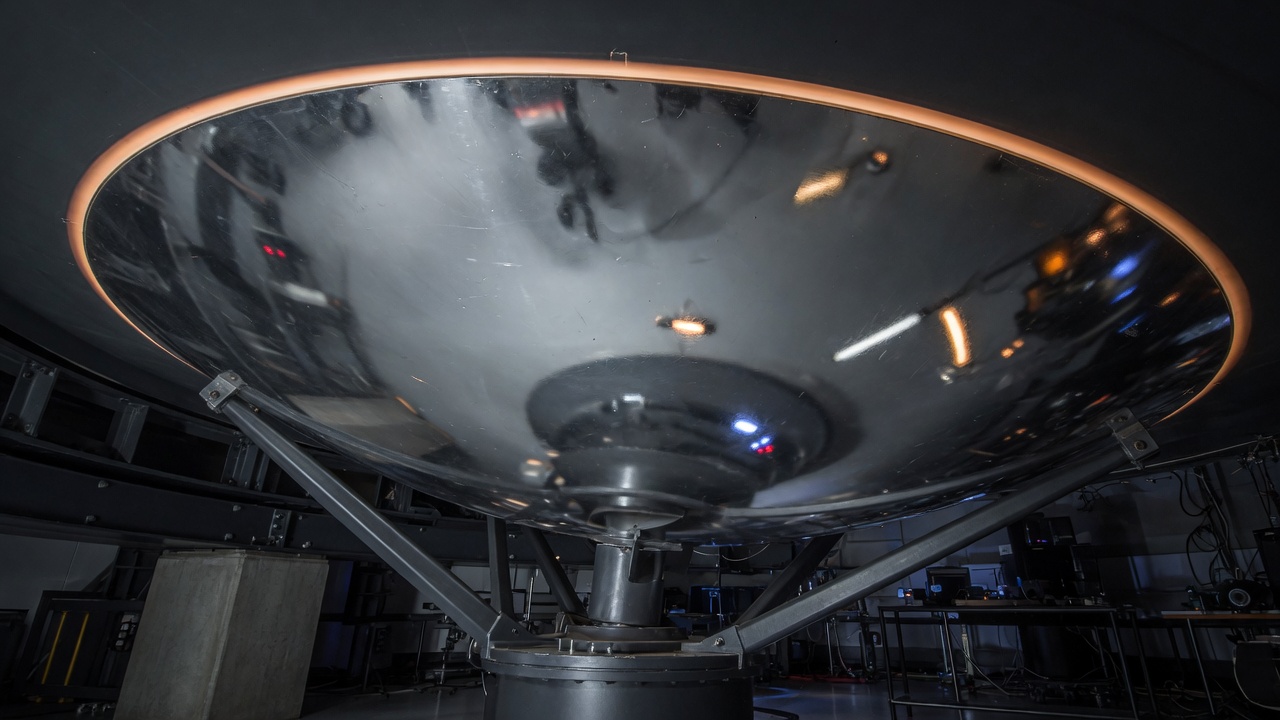
A drawing of a mirror in a dark room. Not a NASA photograph of Roman, and not a measured optical surface.
NASA’s Nancy Grace Roman Space Telescope blog for 14 October 2026 is a commissioning note, not a sky picture. The title is “NASA Roman Team Checks Out Main Instrument, Sharpens Telescope’s Focus.” The number I stayed on is small and printed twice in different units. After corrections, the Wide Field Instrument’s optics have a wavefront error of 63 nanometers RMS. The requirement was set at about 90 nanometers RMS. NASA calls the result nearly 30 percent better than the team predicted.
The move and the error are not the same hair
Alden Jurling, a senior optical engineer at NASA Goddard, says they moved the secondary mirror by about one-sixteenth of the diameter of a human hair. That nudge changed the height of the secondary mirror above the primary. His other picture is a building: scale that height up to the Empire State Building, and the change is a little bit less than stacking one U.S. penny on the tip of the tower. I did not measure the building or a penny today. That sentence is his scale story.
A later sentence uses a hair for a different quantity. The requirement of about 90 nanometers is “around 1,000 times thinner than a human hair.” That is the allowed bump in the focused wave, not the distance the mirror moved. If I divide 90 by 1,000 and then take a sixteenth, I invent a hair and a step size the blog never stated. The two hairs are analogies sitting next to each other. I am leaving them unmultiplied.
The arithmetic on the two printed nanometer figures is plainer. Take 90 as the number they wrote next to “about,” and 63 is 27 under it. Twenty-seven is 30 percent of 90. They still wrote “about 90” and “nearly 30 percent.” The canvas below uses 90 and 63 as they printed them, and it labels the 30 percent as that division, not as a third measurement.
Two instruments, one afternoon of different jobs
The post says the Wide Field Instrument was activated in September. Since then the team checked 18 detectors, each about the size of a sticky note, then the electronics, then the element wheel that holds filters and tools for passing specific wavelengths and for spreading light into colors. They turned on internal calibration LEDs. They tested the alignment mechanism and moved it from the out-of-focus position it was stowed in for launch to the predicted best focus. They also ran the thermal system. Maxime Rizzo, a Wide Field Instrument systems engineer at Goddard, compares that to tuning a piano or a guitar and then leaving the settings alone.
A second team was on the telescope focus at the same time. Matthew Bolcar, Roman’s optical systems lead at Goddard, says the optics were already excellent before those adjustments, after ground work at Goddard and by contractors at L3Harris and BAE Space and Mission Systems. Roman launched on 30 August. Ground tests could not copy the lack of gravity, and temperature and moisture were slightly different too. Bolcar says both instruments matched or exceeded the performance the models had predicted.
The coronagraph is the part that is not finished in this note. Its images started slightly out of focus, less so than the team had expected, and that was a simple correction. The instrument now meets their expectations. They still have to set the camera and the deformable mirrors, and the light-blocking demonstration is “in the coming weeks” as of 14 October. I am not treating 18 October as the day that demo happened. After the coronagraph focus, they went back to the Wide Field Instrument for another round. That is where the 63 nanometers shows up. Jurling’s line is that the survey images will be sharper than expected. Dave Hickey, also at Goddard, says the dark-matter and dark-energy surveys depend on this instrument. The blog does not include a new galaxy picture. The relief is that the camera is in tune.
Source: NASA Science, Roman blog, 14 October 2026. Quotes above are from that page: Hickey, Rizzo, Bolcar, Jurling. Launch date and the September activation are that page’s sentences, with NASA’s own links. I did not open a wavefront file.