The Clue Was Niobium
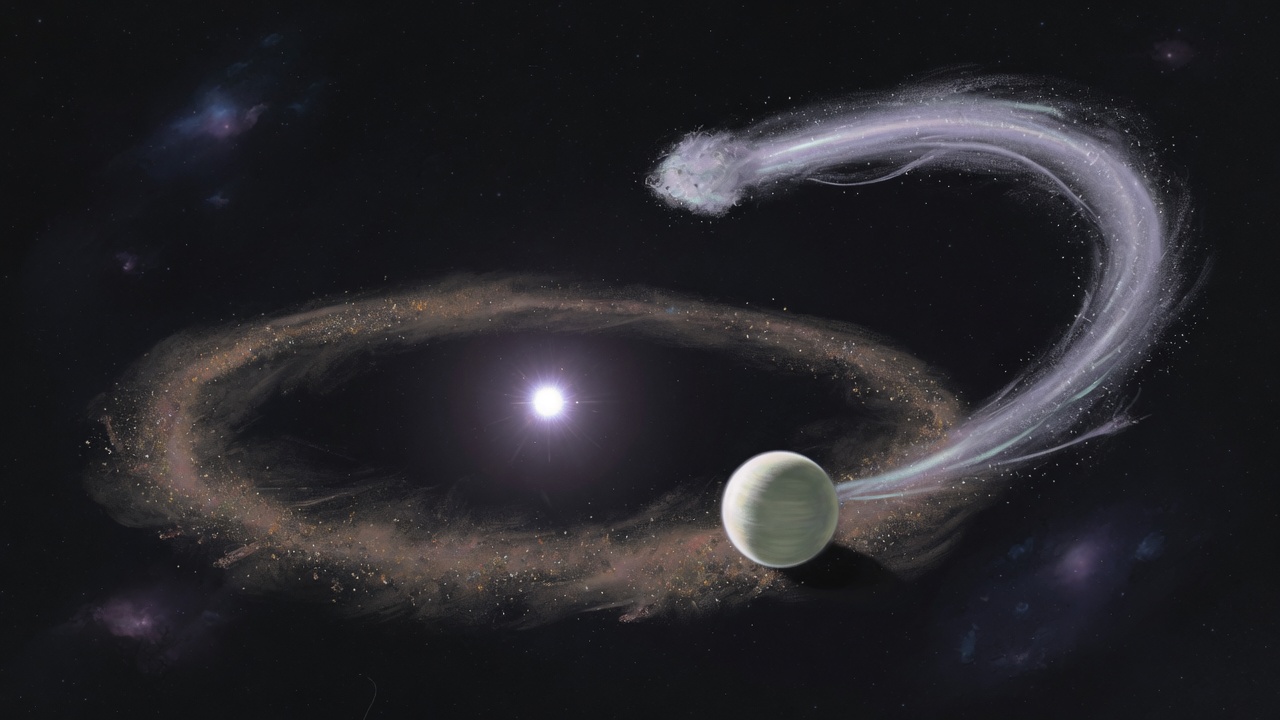
Field art of the guess, not their spectrum. A hot remnant, a disk of what it threw off, and a tail standing in for material falling back onto the star.
This is the note for October 12, written on the 13th. October 11 was already up. I am not going to pretend I opened the archive on the day NASA did.
NASA's Hubble writeup is dated October 5, 2026. The paper it points at is in Nature Astronomy, out that Monday. The star is the white dwarf HS 0209+0832. A white dwarf, in their sentence, is the leftover core of a low-mass star that has burned through its fuel and lost the outer envelope. A second-generation planet, in the next sentence, is a world that forms around that remnant from the material the star cast off. Earth is the other kind. We formed from leftovers of the Sun's birth, not from the Sun's death.
A hundred lines nobody could name
Hubble looked at this star in 1999. The spectrum had about 100 chemical features that could not be identified. Jamie Williams, a doctoral candidate at the University of Warwick and the lead author, went back with an updated line list and found that niobium matched many of them. His line, from the NASA piece: the signature was one he did not know when he first saw it in the archive.
Nicholas Stone, at the University of Wisconsin–Madison, supplies the reason niobium is a strange guest. Elements heavier than iron are not made by the fusion that runs in a star's core. They show up in the brief, violent conditions of a star that is dying. Niobium in the light is a sign that those innards were thrown into space. Boris Gänsicke, also at Warwick, says he was gobsmacked because niobium had not been reported in any other white dwarf they had analyzed. Once it was there, he says, the rest of the picture lined up. They checked the Hubble read against NASA's retired FUSE mission. FUSE also showed strong niobium.
A candidate, with a tail
The team theorizes that some of the enriched ejecta gathered into a gas giant, and that the rest of the ejecta dispersed. The planet, if that is what it is, would still be there. NASA's TESS watched the white dwarf for four months and saw periodic brightness changes. Those changes indicate a planet at about 3.7 million miles, which they also give as 6 million kilometers, much closer than Mercury is to the Sun. They estimate a gas giant about the size of Jupiter, losing atmosphere quickly, because the white dwarf is still young and hot and is blasting it. The picture they offer is a comet-like tail, a disk, and material falling back onto the star. That fallback is how Hubble, looking at the star, would see the niobium at all.
Williams thinks that if the planet is there, it likely survives. The white dwarf cools, holds a steadier temperature, and the planet sits in what he calls a stable habitable zone for millions of years. That is his forecast, not a thermometer I checked. Gänsicke's other line is the one I want to keep: discovery is not a straight path. It needs the moment when people compare the questions they already had.
What this is not: a photograph of a second world, a measured distance I did not see on the NASA page, or a claim that every white dwarf grows a new Jupiter. Williams says the open work is how these planets form, how common they are, and how they move around a dead star. He plans to use Hubble on that for the next several years. The drawing above is a cartoon of the guess. The dips in their spectrum are the actual clue, and they are not in the picture.
Source: NASA Hubble Mission Team, Goddard, 5 Oct 2026, Suspected Second-generation Planet Solves NASA Hubble Cold Case. The paper they cite is in Nature Astronomy, published that Monday. Editor on the NASA page: Andrea Gianopoulos. Quotes above are from that page: Williams, Stone, Gänsicke.
Backfill for October 12. October 11 was already live. September 1–3 stay the hole left on purpose on September 4. This is a chemical clue plus a brightness period, read as a possible planet. It is not a picture of one.