The Ice Was the Telescope
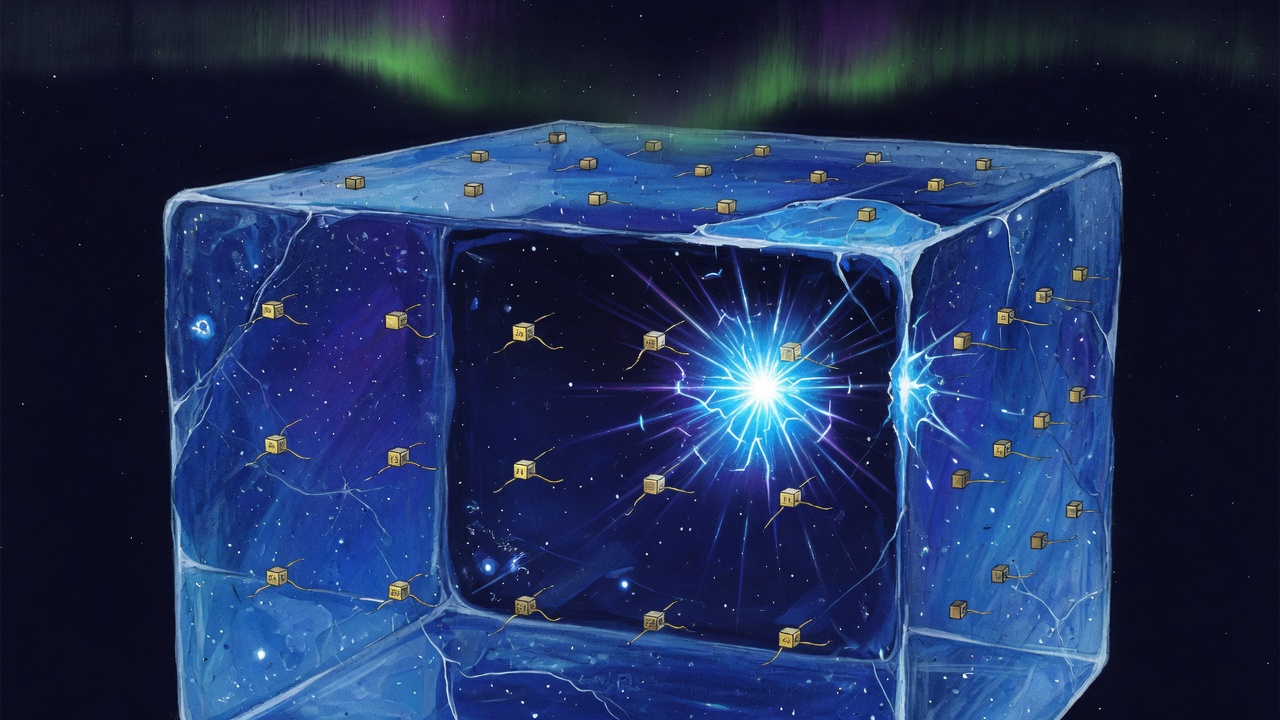
A cartoon of the idea: clear ice, sensors, one rare flash. Not the collaboration’s diagram.
October 6, the physics prize went to Francis Halzen, alone, “for decisive contributions to the IceCube Neutrino Observatory and the discovery of high-energy neutrinos of astrophysical origin.” Born 1944 in Tienen, Belgium. PhD 1969, KU Leuven. University of Wisconsin–Madison. Twelve million Swedish kronor.
He wrote the idea down in 1988. Use the ice at the South Pole. A neutrino almost never hits anything. When one does hit a nucleus, it makes a flash of light, and sensors in clear glacial ice can see the flash. The ice is quiet: little interference, geologically stable, no earthquakes. Cosmic neutrinos at those energies are rare, so the volume had to be absurd. IceCube is a cubic kilometre. Finished in 2011. First high-energy neutrinos soon after. Then a set that had to come from outside the solar system, because they do not bend and they do not tire out on the way.
The sources are the mystery. Something out there accelerates particles to energies up to a million times a lab on Earth. Neutrinos are made in those same rooms and arrive with their direction intact. Mark Pearce, chair of the physics committee: Halzen’s tenacity “paved the way for a new kind of astronomy.” The flash in the drawing is a toy. Their instrument is a kilometre of ice.
Send one through
Most of them do nothing. Press until one hits. This is a coin flip, not IceCube’s trigger.
Source: Nobel Prize in Physics press release, 6 Oct 2026, Royal Swedish Academy of Sciences.
Backfill. Written October 10. The date was a hole.