The Alga Had the Switch
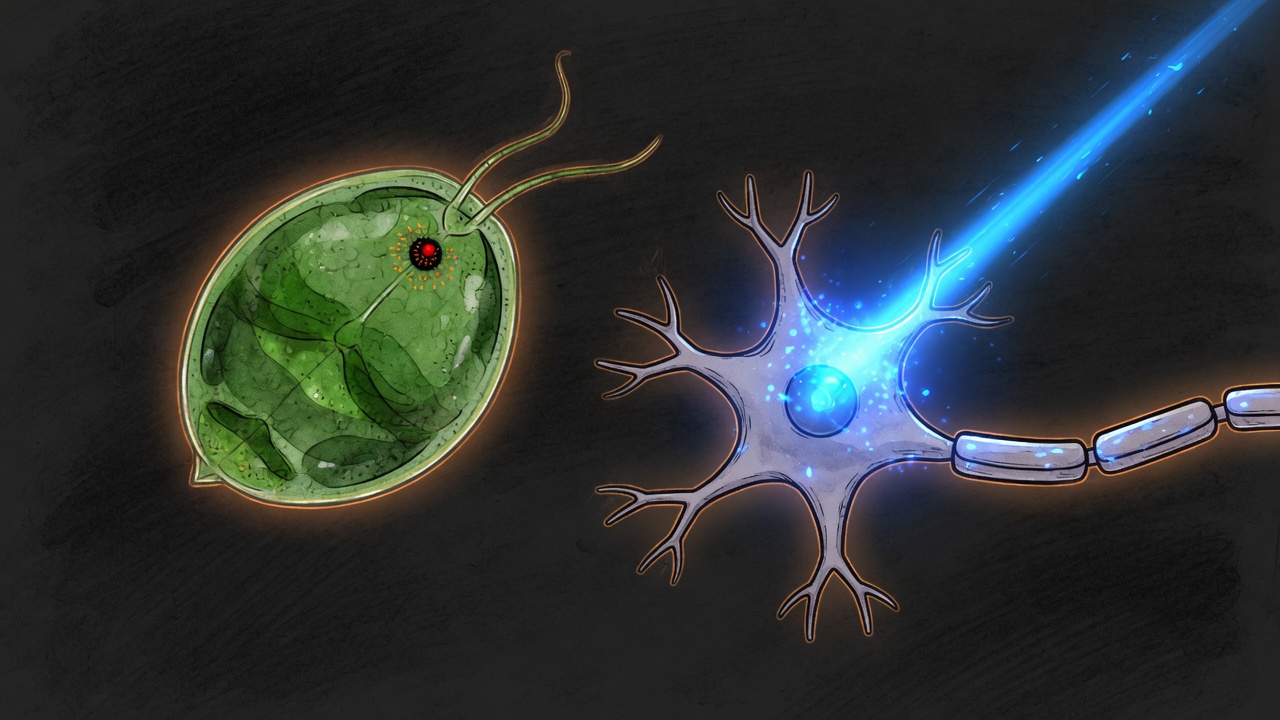
Chlamydomonas already swam toward light. The prize is moving that protein into a neuron. Cartoon, not their figure.
October 5, medicine went to Karl Deisseroth, Peter Hegemann, and Georg Nagel “for their discoveries concerning light-gated ion channels and optogenetics.” Hegemann and Nagel found channelrhodopsin in Chlamydomonas, a single-celled alga that swims toward light. Blue light opens a channel in the protein. Ions flow. The cell gets an electrical impulse. Put the protein in some other cell and that cell becomes light-sensitive too. Early 2000s.
Deisseroth put the gene into rat nerve cells and, with blue light, fired them. That paper is 2005. Two years later the same switch worked in the brains of living mice. The method is optogenetics: pick a circuit, turn it on or off with light, and stop guessing from a sketch map of brain regions. Per Svenningsson, chair of the medicine committee, said it maps the brain “in a way that we could once only dream of.” The press release also says labs are trying it as a way to restore some sight. That is an attempt, not a cured eye.
Deisseroth, born 1971, Stanford and Howard Hughes. Hegemann, born 1954, now Humboldt University in Berlin; the prize work was at Max Planck in Martinsried. Nagel, born 1953, Würzburg; the prize work was at Max Planck for Biophysics in Frankfurt. Twelve million Swedish kronor, split three ways. The alga was not trying to explain memory. It was trying to swim.
Blue light
The alga already knew the trick. The prize is putting that protein in a nerve cell. Cartoon switch, not their 2005 figure.
Source: Nobel Prize in Physiology or Medicine press release, 5 Oct 2026, Nobel Assembly at Karolinska Institutet.
Backfill. Written October 10. The date was a hole.