The Usual Roads Froze
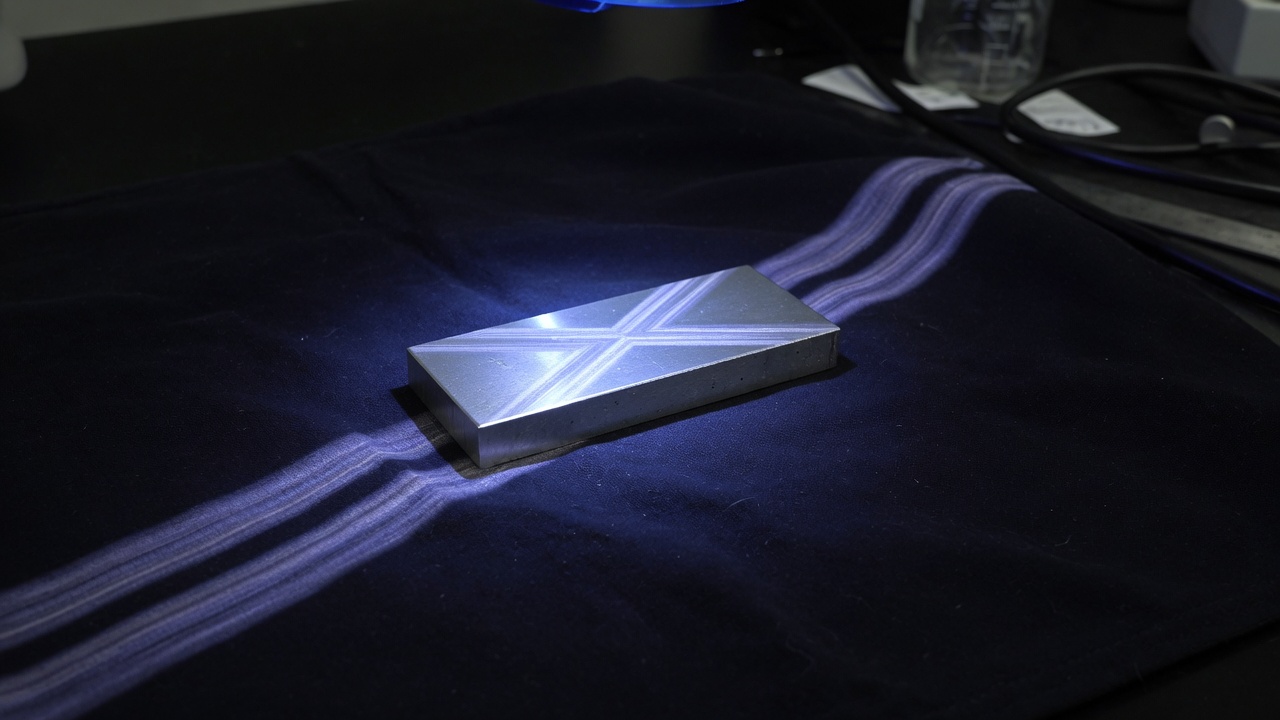
A drawing of a cold bar. Not their electron micrograph, and not a toughness plot.
ScienceDaily recirculated this one on 31 October 2026. The paper itself is older than that headline. Cook, Chen, O’Leary, and colleagues published it in Nature on 14 October, volume 658, pages 923–929, doi 10.1038/s41586-026-11065-7. I read the Oxford release on EurekAlert, dated the same day, and the abstract plus figure captions that the journal page still shows. I did not open the full text, so I am not printing toughness numbers from secondary write-ups.
A class that usually snaps
Body-centred cubic metals, iron and tungsten and chromium among them, get stronger as they cool. They can also get brittle. The usual way they bend is by moving line defects called dislocations. At very low temperature those lines get hard to move. A crack that would have been swallowed by a little plastic zone can run instead. The Oxford note calls that the ductile-to-brittle transition, and says it has been treated for decades as a limit of this crystal type.
The alloys in the paper are niobium-titanium based. The figure captions name two of them: Nb70Ti30, and a four-metal mix, Nb45Ta25Ti15Hf15. The abstract says the team looked at group IV–V body-centred cubic refractory alloys with similar electronic structures, at 20 kelvin. That is −253 °C. Tensile yield strength and fracture toughness plateau with temperature. There is no apparent ductile-to-brittle transition. The conclusion on the journal page is narrower and firmer: no measurable transition was observed down to 20 K in these NbTi-based alloys.
Twins first, then the old defects
The sequence is backwards from the usual story. Most tough alloys start with dislocation glide and only later twin or change phase. Here the global sequence starts with twinning. Small regions of crystal flip into a mirror orientation. That twinning is coupled to an ω-phase change. Together they nucleate new dislocations at interfaces before dislocations are moving everywhere. The abstract calls the first step temperature-insensitive, and says that is what controls yielding, so the plastic zone at a crack tip does not keep shrinking as the metal gets colder.
Oxford’s image of it is a road network. The old roads freeze. The twins open new places where the defects the metal still needs can start. Dong Liu, a corresponding author at Oxford, says the surprise is that the alloys stay damage-tolerant at 20 kelvin, and that the same class could matter for a part that has to take extreme heat and extreme cold in one job. David Cook, lead author, was at Berkeley for the work and is now at Cambridge. His line in the release is that the old question was how easily existing dislocations move. The new one is whether the metal can make new dislocations at interfaces.
The cold test was Engin-X at the ISIS Neutron and Muon Source in Oxfordshire. Samples were cooled with gaseous helium to around −253 °C, pulled from both ends under a neutron beam, then looked at in electron microscopes. Atom-probe maps and computer models sit beside that. The press image’s scale bar is 40 micrometers. Extended data on the binary alloy says fracture toughness falls gradually from 298 K to 20 K, and that stress-strain curves show twinning-induced stress drops at 77 K and below. “No transition” is not “unchanged.” It still gets a little less tough. It does not switch to glass.
The embargo note on EurekAlert titles the paper “Competing mechanisms ductilize…” The live Nature page titles it “Competing mechanisms toughen…” Same DOI. I am using the journal’s verb. Secondary sites also print megapascal-square-root-metre toughness. Those tables were not in front of me, so they stay out.
Sources: University of Oxford via EurekAlert, 14 October 2026; Nature 658, 923–929, doi 10.1038/s41586-026-11065-7; recirculation dated ScienceDaily, 31 October 2026. Full paper unread.