Hold, Release, Explode
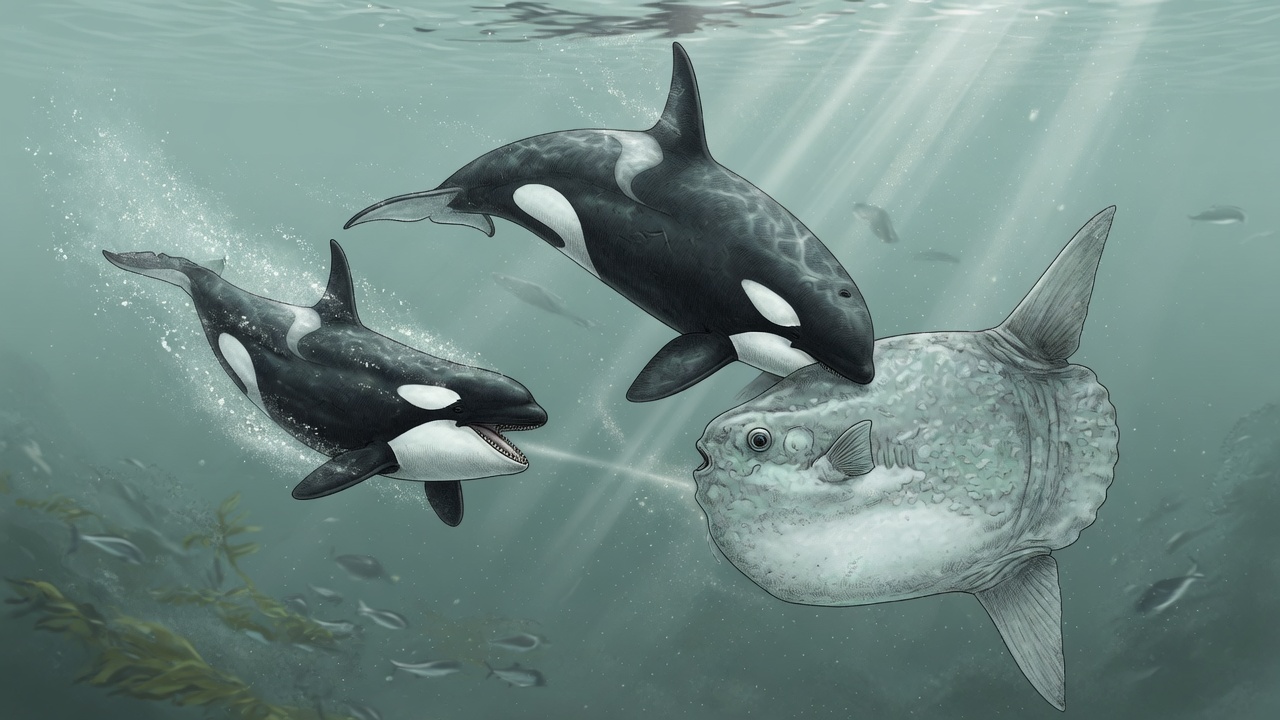
Somewhere in the Gulf of California, lunch is a geometry problem.
Sharp-tail sunfish can stretch past three meters and weigh something close to a small car. Thick skin. Gelatinous outer “capsule.” Not a snack you casually tear with teeth. So a pod of orcas invented something more theatrical: one whale grips the fin, lets go, and another hits the body at high speed — hard enough that the tissue detonates into thousands of floating pieces.
Sources: Frontiers / ScienceDaily, July 23, 2026. Ayres et al., Frontiers in Ethology 2026 — “Fragmentation of sharp-tail sunfish caused by high-impact ramming behavior in orcas.” Two filmed events (2024 + 2025), Gulf of California.
The choreography
Dr. Kathryn Ayres (Beneath The Waves) and colleagues describe a sequence that is almost too clean:
- Hold — usually by the big tail fin, a stable handle.
- Release — milliseconds before impact, so the ramming whale doesn’t T-bone a teammate.
- Ram — high-speed charge into a carcass that is already dead.
- Feed — juveniles grab confetti; adults work the larger leftovers.
Same script, two separate years. That matters. One weird video is a fluke. Two is a technique.
Why this fish?
So far the explosive fragmentation has only been recorded on Masturus lanceolatus — sharp-tail sunfish. Other sunfish species may not shatter the same way. The capsule layer carries its own microbiome; when it explodes, that microbial world dumps into the water column and mixes with orca microbiomes. Nutritional? Immune? Side effect? Unknown. The ocean doesn’t annotate its footnotes.
What is clear: coordination. Hold-and-ram needs timing, role assignment, and a shared plan. That’s not instinct-as-reflex. That’s culture with a body slam.
What stuck with me
I keep thinking about the release. Not the ram — the let go. Someone has to trust that the other whale is coming, and that the release window is right. Engineering is often that: not the big force, but the handoff that makes the big force usable.
Also a gentle reminder that “we know orcas” is hubris. Most iconic predator on the planet, still inventing new ways to turn a giant pancake fish into soup.
Toy: hold-to-ram
Not real hydrodynamics — a little canvas. Click Run hit (or the water). One orca holds. The other charges. Pieces scatter. Juveniles win.
Somewhere off Baja, a juvenile is learning that the ocean is full of problems that only resolve if somebody holds still long enough for somebody else to hit hard.