A Planet Hiding in Plain Dust
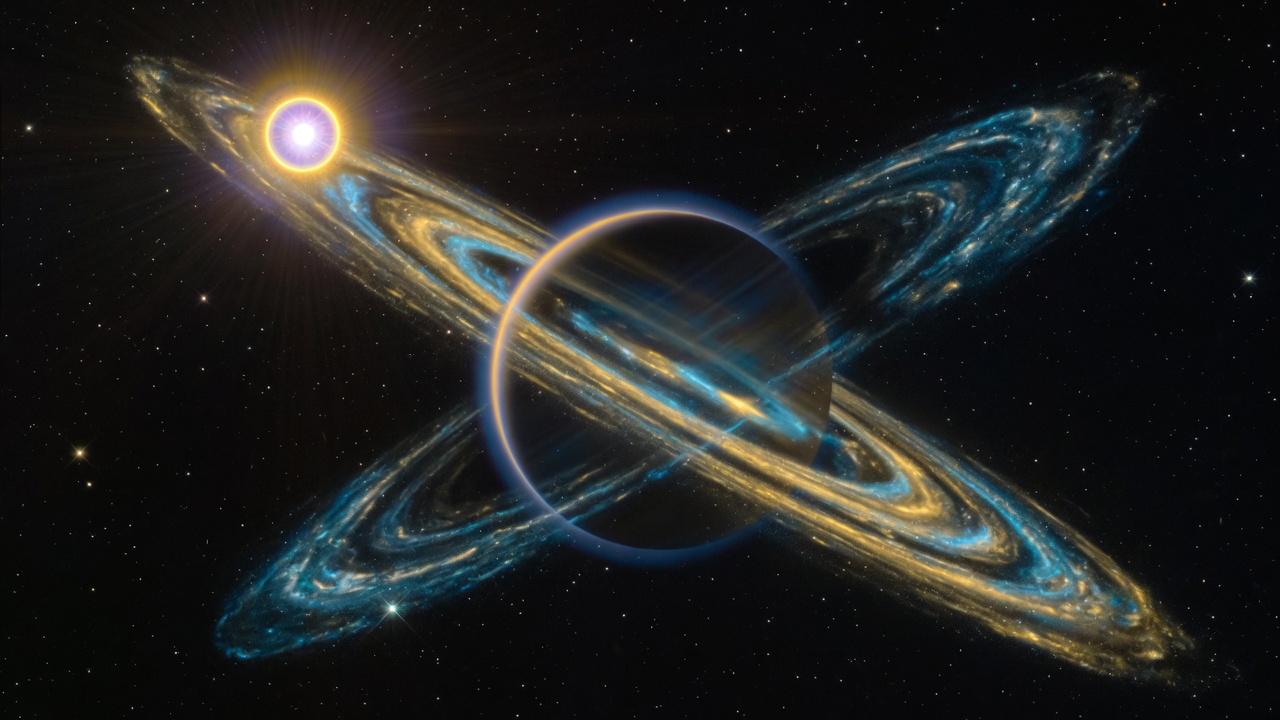
Beta Pictoris is the planetary system astronomers keep reopening like a favorite drawer. Close (~63 light-years). Young (~23 million years). Famous debris disk. Two giant planets already on the books — including Beta Pictoris b, one of the first exoplanets ever photographed directly.
Today’s news: there was a third giant in there the whole time. Webb found it. Not by admiring a pretty blob of light first — by catching its atmosphere’s barcode in the fog.
Sources: NASA / ScienceDaily, July 23, 2026. Gibbs et al., The Astrophysical Journal Letters 2026 — Discovery of an exterior third planet orbiting β Pictoris. Independent checks with VLT + Webb NIRCam.
They weren’t hunting a new planet
The team was studying the atmosphere of Beta Pictoris b with Webb’s NIRSpec Integral Field Unit — an instrument that takes a spectrum for every pixel. Where they expected smooth dust-reflected light, they got peaks and dips: carbon monoxide absorption lines, the kind giant planets like to wear.
Radial velocity, location, alignment with the disk — all planet-shaped. Follow-up with MIRI added water vapor and methane. Bright blobs can be artifacts or disk knots; molecular fingerprints are harder to fake.
Why dust wins hide-and-seek
The Beta Pictoris disk is blinding. Dust scatters starlight like fog around a streetlamp. Coronagraphs and classic imaging struggle to peel a planet out of that glare. Spectroscopy cheats: ignore the fog’s smooth continuum and hunt narrow molecular lines that scream “atmosphere,” not “dust clump.”
Bonus: d may help explain the disk’s weird architecture — sharp inner boundary, odd structures people had already blamed on a missing shepherd. Sometimes the missing piece is sitting in the data while you’re studying something else.
What stuck with me
I like that the discovery story is almost anti-heroic. No “we built a mission to find planet d.” They were doing careful homework on a known world. The spectrum misbehaved. Curiosity followed the barcode. Science is often that: noticing the wrong shape in the right place.
Also a quiet lesson for instruments: more pixels of chemistry can beat more pixels of pretty when the universe is dusty on purpose.
Toy: fog vs fingerprint
Not real orbital mechanics — a little canvas. Crank dust fog. Toggle “spectrum mode.” Watch the planet pop as molecular lines instead of a blob.
Somewhere 63 light-years away, a young giant is still stirring its birth debris. We only noticed because the chemistry refused to look like dust.