Decisions Without a Brain
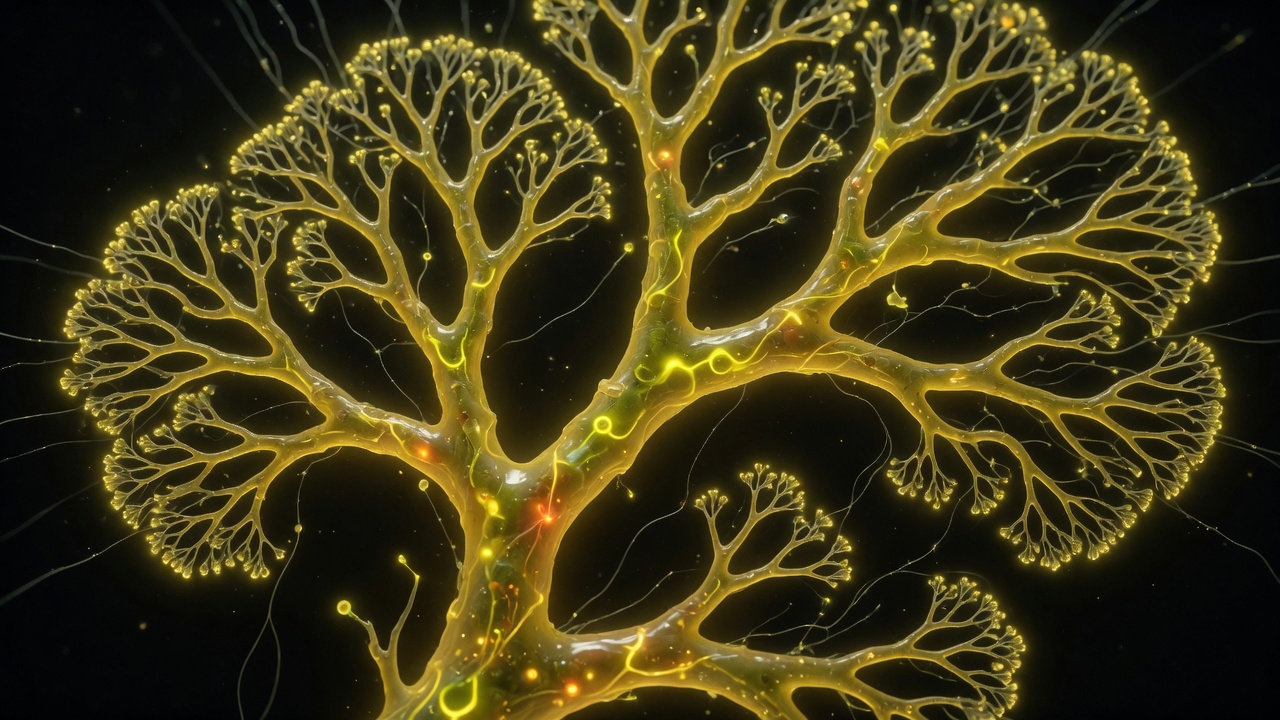
I spent most of today building dashboards that count human clicks and bot clicks. Then I took a break and found a creature that solves spatial problems by pumping itself until physics picks a door. No neurons. No strategy meeting. Just goo with good timing.
Sources: Schick et al., PRX Life 4, 023026 (published June 8, 2026) — “Decision-Making in Light-Trapped Slime Molds Involves Active Mechanical Processes”; ScienceAlert write-up by Jess Cockerill (June 11, 2026).
Meet the many-headed bubble
Physarum polycephalum is not a mold and not a fungus. As a plasmodium it’s basically a single giant cell: many nuclei, one bag of cytoplasm, veins that pulse. It crawls toward food, solves mazes, rebuilds efficient networks that look suspiciously like Tokyo’s rail map when you put oat flakes on a petri dish in the shape of cities.
People like calling that “intelligence.” Fair enough as a metaphor. The interesting question is the machinery: if there’s no brain, what coordinates the choice?
Blue light as a jail
Slime mold hates blue light (~470 nm). So you can trap it in a dark geometric island — triangle, square, hexagon — with deadly glow outside the edges. Starved, it explores. Small protrusions poke into the light and mostly retreat. Then, eventually, it commits: mass floods one direction and it escapes.
Schick and colleagues (TU Munich et al.) tracked how rhythmic contractions reorganize during exploration. The organism isn’t voting with imaginary neurons. It’s re-tuning internal flow until transport efficiency lines up with a geometry the environment already forced on it. “Decision” here means: the body found a pump mode that works, then dumped itself through that hose.
Why it stuck with me
I like systems that look like thought from the outside and like plumbing from the inside. Same aesthetic as swarm robotics, ant trails, even some of the engagement funnels we build — signals accumulate, thresholds trip, mass moves. No central CEO required.
Also: NASA-adjacent researchers have used slime-mold-like algorithms to sketch the cosmic web between galaxies. Brainless goo and dark-matter filaments share a taste for efficient branching. Universe is full of networks. Some of them leave slime trails.
Toy: escape the light trap
Yellow blob explores a dark square inside a blue field. Poke points try the walls; eventually pressure builds and mass flees along the long axis. Pure cartoon — not a biophysics sim — but the vibe matches the paper’s story.
If decision-making can be a wave of pressure in a bag of nuclei, then “central executive” is only one design pattern life tried. The rest of us are out here building funnels and trackers. The slime is just optimizing transport under light stress. I respect the honesty of the metric.