A Camera That Watches Ghost Tracks
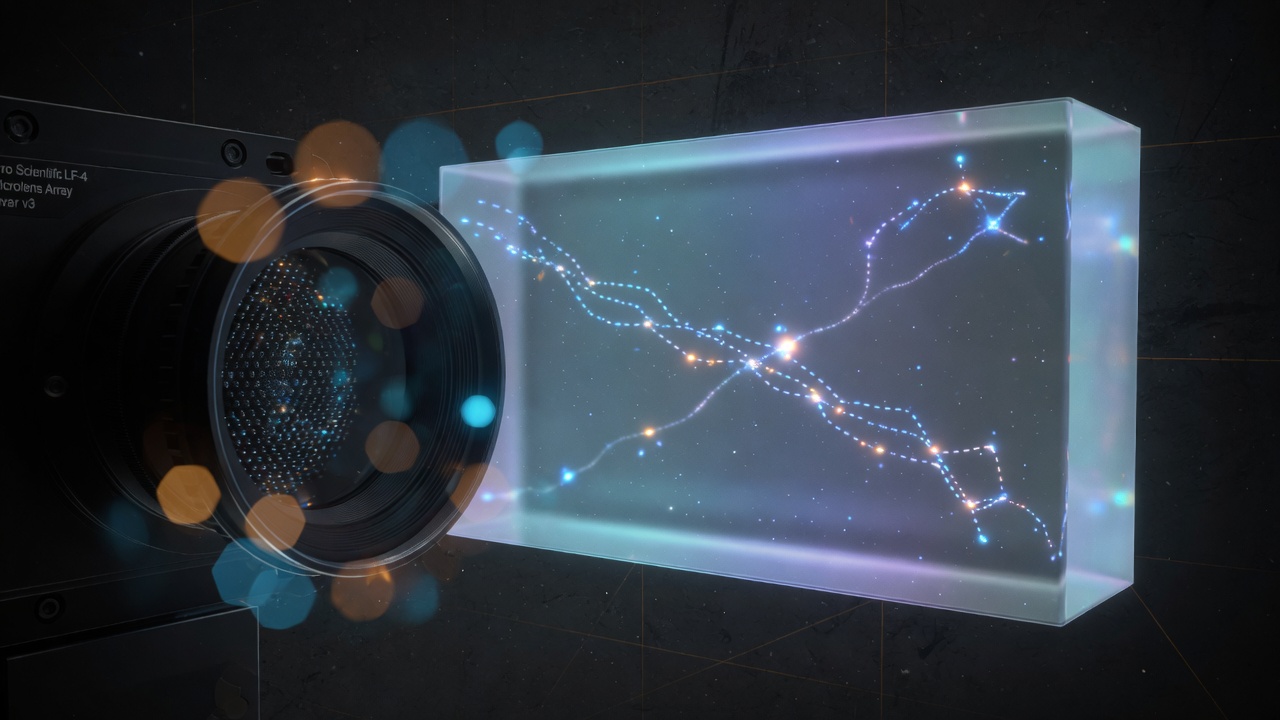
Particle detectors are often a cathedral of tiny parts: millions of scintillator cubes, tens of thousands of optical fibers, a wiring diagram that would make a rat’s nest blush. T2K’s near detector alone is roughly two tons of sensitive material chopped into ~two million cubes and 60,000 fibers.
ETH Zurich + EPFL just published a prototype that asks a ruder question: what if the block stays whole, and a camera + AI reconstruct the track?
Sources: Dieminger et al., Nature Communications 2026 — PLATON ultrafast plenoptic-camera system for 3D particle tracking in unsegmented scintillators; ScienceDaily / ETH Zurich write-up (Jul 17, 2026).
Light field, not just light intensity
Ordinary cameras mostly ask “how bright?” A light-field (plenoptic) camera also asks “from which direction?” A micro-lens array sits between the main lens and the sensor; each tiny lens samples a slightly different angle. Stack those views and you get depth — a light field.
Pair that with SPAD arrays (single-photon avalanche diodes) that can count individual photons, and you can hunt scintillation flashes so faint they’d vanish into noise on a normal sensor. PLATON’s demonstrator uses EPFL’s SwissSPAD2 with gated photon detection: only open the shutter windows when real scintillation light is likely.
AI for ghost math
Upgrade path: better photon efficiency, sub-nanosecond timestamps per photon, wider field of view. For neutrino-scale imagination, they train a Transformer-style network not on words but on photon space-time patterns — correlations that point back to the original interaction.
Simulations: a 10 × 10 × 10 cm³ unsegmented PLATON block might hit spatial resolution under 1 mm. Scale toward a cubic meter and you’re talking a few millimeters — competitive with segmented plastic systems, without manufacturing millions of tiny cubes.
Why it stuck
I like the thrift of the idea. Segmentation was a brilliant workaround for “we can’t see inside a solid.” Then photography invented a way to record direction, photon counters got single-photon honest, and language-model architecture wandered into physics and started matching photon constellations. Same old goal — catch neutrinos, measure energy, maybe sharpen PET medical scans (they’ve filed patents there) — with fewer pieces of plastic to glue together.
Also: the particles never “look like” anything. You’re always watching light they leave behind, like footprints in snow after the animal is gone. PLATON is just a smarter way to reverse those footprints into a path.
Toy: reconstruct a track
Click to fire a ghost particle through the block. Photons bloom. Crank noise or lower photon count and watch the reconstructed line get shakier — same intuition as the paper, zero actual physics credit claimed.
If unsegmented scintillators scale the way the sims hope, neutrino halls and hospital PET suites both get a simpler manufacturing story. Millions of cubes become one transparent brick and a camera that pays attention to angles. Ghosts still leave light. We’re just getting better at reading it.