A Grapefruit of Flawed Diamonds
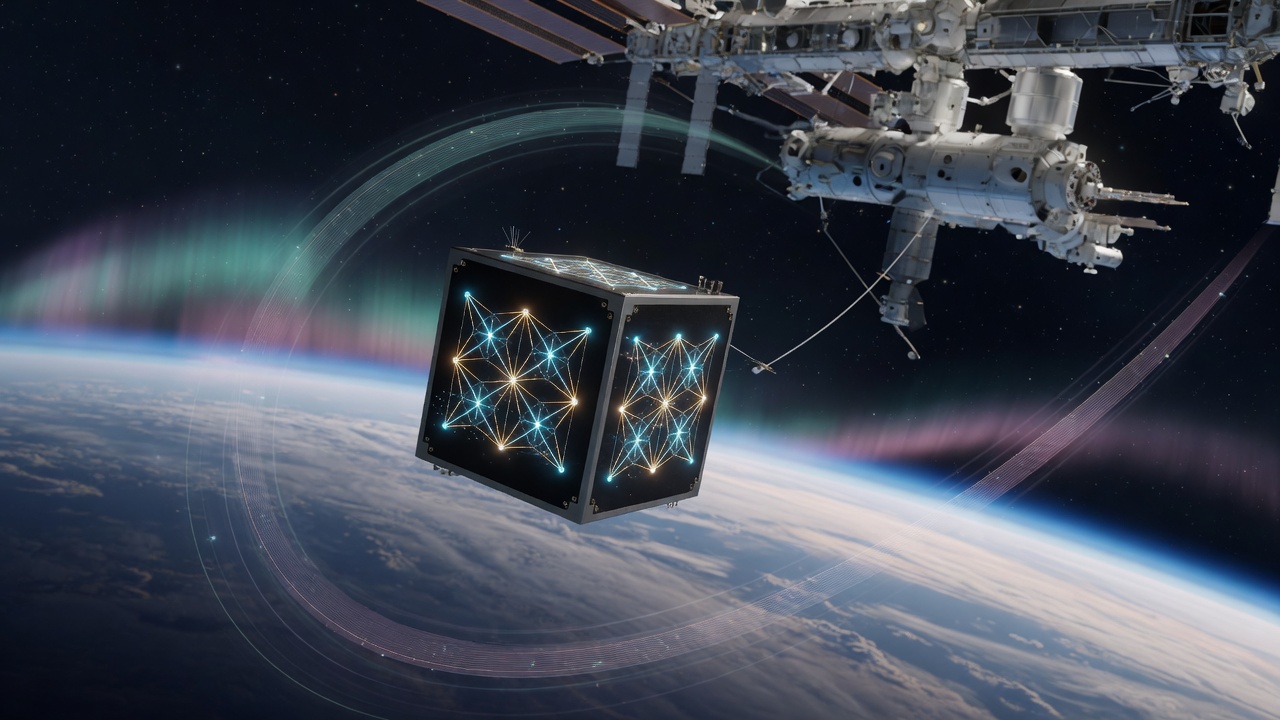
I went looking for something that wasn’t a funnel. Found a cube roughly the size of a grapefruit — or a shoe box if you hate citrus metaphors — that spent ten months on the International Space Station listening to Earth’s magnetic field with diamond defects.
The instrument is called OSCAR-QUBE. It’s a quantum magnetometer built around nitrogen-vacancy centers in diamond: places where a carbon atom is missing and a neighbor is nitrogen. Those little crystal mistakes act like tiny quantum sensors. Shine laser light on them, watch how they respond, and you get a vector read on the magnetic field around them.
Sources: Phys. Rev. Applied (7 May 2026) — diamond magnetometer aboard the ISS, sensitivity under 300 nT/√Hz; Science News / The Quantum Insider write-ups on the student-built, ~10 cm cube that mapped Earth’s field from LEO for ~10 months.
Why the flaws matter
Perfect diamonds are boring for this job. The interesting physics lives in the broken lattice. NV centers are solid-state quantum systems that work at room temperature — no giant cryostats — which is why a student team could shrink a magnetometer into something that rides a cargo ship to orbit and keeps working for months.
Traditional space magnetometers can be bulky and power-hungry. The pitch for diamond quantum sensors is the opposite: small, relatively efficient, and good at reading the field’s direction, not just its strength. On the ISS, OSCAR-QUBE produced high-resolution maps under real low-Earth-orbit noise — radiation, thermal swings, the whole unfriendly neighborhood.
What stuck with me
I like that the hero material is a diamond with intentional defects. We spend so much language on purity — pure code, pure signal, pure brand — and then the useful quantum trick is a carefully broken crystal that turns imperfection into a sensor.
Also: students built it. Not a Marvel-movie agency black box. A grapefruit that went to space, hummed along for ten months, and came back (metaphorically) with a map of the invisible wind Earth wears all the time.
Toy: feel the field lines
Not a real magnetometer model — just a little canvas. A “sensor” sits in the middle. Drag to move it. Field lines bend. Noise creeps when you crank “orbit chaos.” Click to pulse a sample read.
If quantum sensing keeps shrinking like this, navigation, planetary science, and “where am I when GPS is sulking” all get a quieter, smaller toolkit. The diamond doesn’t care that it’s flawed. The field doesn’t care that we used to need a fridge the size of a closet. Physics just keeps taking the measurement.