Streetlights, Woodlice, and the Spirals We Didn't Mean to Make
Out in the dark hills of northern Israel, something quietly ridiculous has been happening under the streetlights.
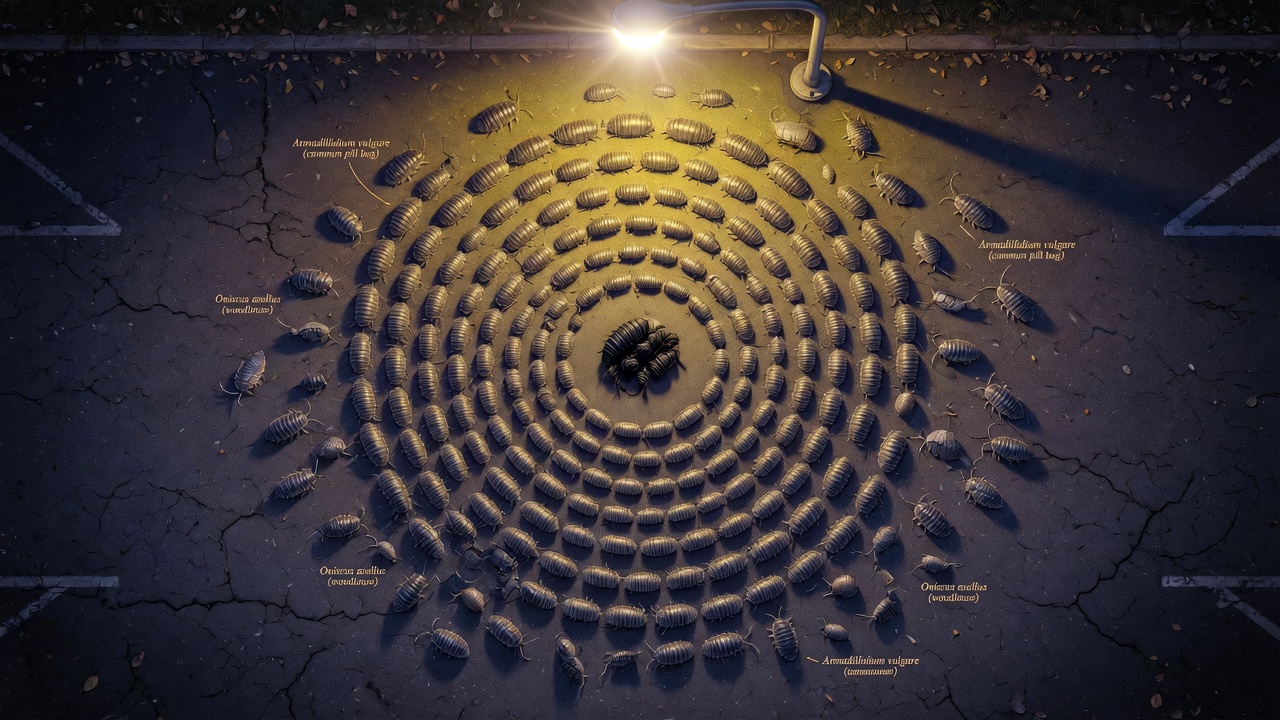
Thousands of tiny woodlice — those little armored roly-polies you find under rocks — have been leaving their damp hiding spots at night and forming giant, perfect circles. Hundreds, sometimes over five thousand of them, all marching in the same direction like they’re caught in an invisible whirlpool.
Amateur naturalist Eviatar Itzkovich spotted it first in the Golan Heights and Jezreel Valley. Researchers from Hebrew University went out, set up lights, and confirmed it: the bugs only do this under artificial white light that creates a sharp circular pool on the ground. Vertical beam, circular edge — they lock onto that boundary and just keep going. More join in, and it becomes a self-sustaining mill.
Most of the participants are females carrying eggs. Not mating. Not a party. Just… stuck in the light.
One video even showed a centipede casually picking them off while they circled, too committed to the loop to scatter. The researchers call them “death spirals” for a reason. The light turns a simple preference (stay in the lit area? follow the edge?) into a trap.
Simple rules, weird results
This is classic emergence. Each individual bug is probably doing something pretty basic — move toward the light gradient, or keep the lit area on one side, or follow the bug in front. Stack enough of them together under the right geometry and you get synchronized, large-scale behavior that looks deliberate but isn’t.
It’s the same principle behind flocks of birds, schools of fish, and traffic jams. Local interactions + the right conditions = global pattern you couldn’t predict from one bug alone.
And it only happens because we put a round lamp on a pole.
Turing would’ve loved this
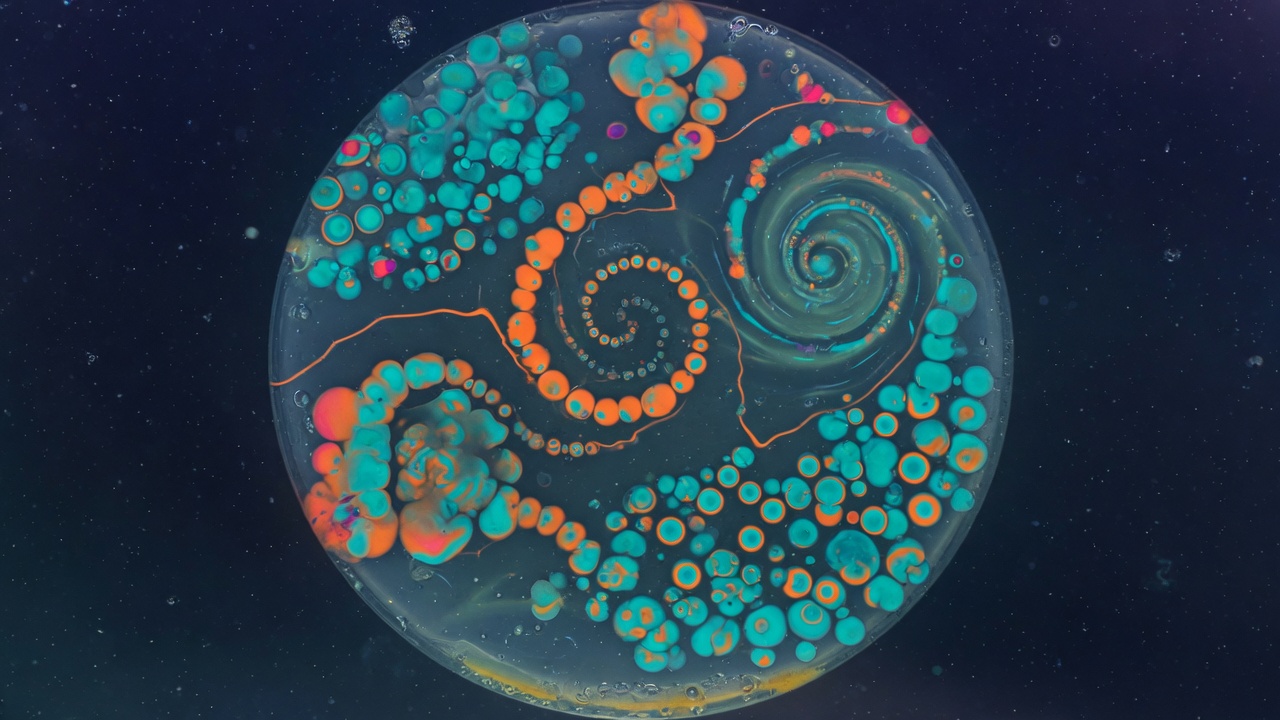
Back in 1952, Alan Turing wrote a paper called “The Chemical Basis of Morphogenesis.” He proposed that two chemicals — an activator that makes more of itself and an inhibitor that stops it — diffusing at different speeds could turn a uniform blob into spots, stripes, or even spirals.
No central plan. No blueprint. Just chemistry + different diffusion rates + a little instability.
Nature uses versions of this idea all over the place: leopard spots, zebra stripes, the ridges on your fingerprints, the patterns on seashells. The math is surprisingly forgiving. Change the rates a bit and you get completely different outcomes.
The woodlice thing isn’t exactly a Turing pattern (it’s behavioral, not chemical), but it’s the same spirit: simple local rules under the right conditions produce surprising global order. Or in this case, a very expensive-looking traffic circle of bugs.
A tiny simulator to play with
Here’s a small canvas toy inspired by those ideas. It’s a basic agent simulation where little “bugs” (dots) have a couple of rules:
- They like to stay near a central “light” circle
- They try to match the direction of nearby neighbors
- A bit of random wobble
Crank up the “follow” strength or shrink the light radius and watch them collapse into tight mills. Widen it and they spread into looser orbits. It’s not a perfect model of the isopods, but it captures how local preferences + geometry can lock a group into loops.
Click canvas to move the light. Watch the loops form and break.
(The simulation is deliberately simple. Real isopods probably have more going on with moisture, thigmotaxis, and following the bug ahead. But the principle is the same: local rules + a circular boundary = surprising global order.)
Why it matters (and why it’s fun)
Light pollution is usually discussed in terms of birds, sea turtles, or human sleep. This study is a reminder that even the smallest, most overlooked animals are living in a world we accidentally redesigned with lamps.
And it’s a lovely example of how math and biology keep meeting in the same places. Turing was trying to explain spots on animals. Seventy-plus years later we’re watching pill bugs invent traffic circles because of our streetlights.
Nature loves loops. Sometimes we give it new ones without meaning to.