What happens when a free PDF, some cardboard, and basic physics collide.
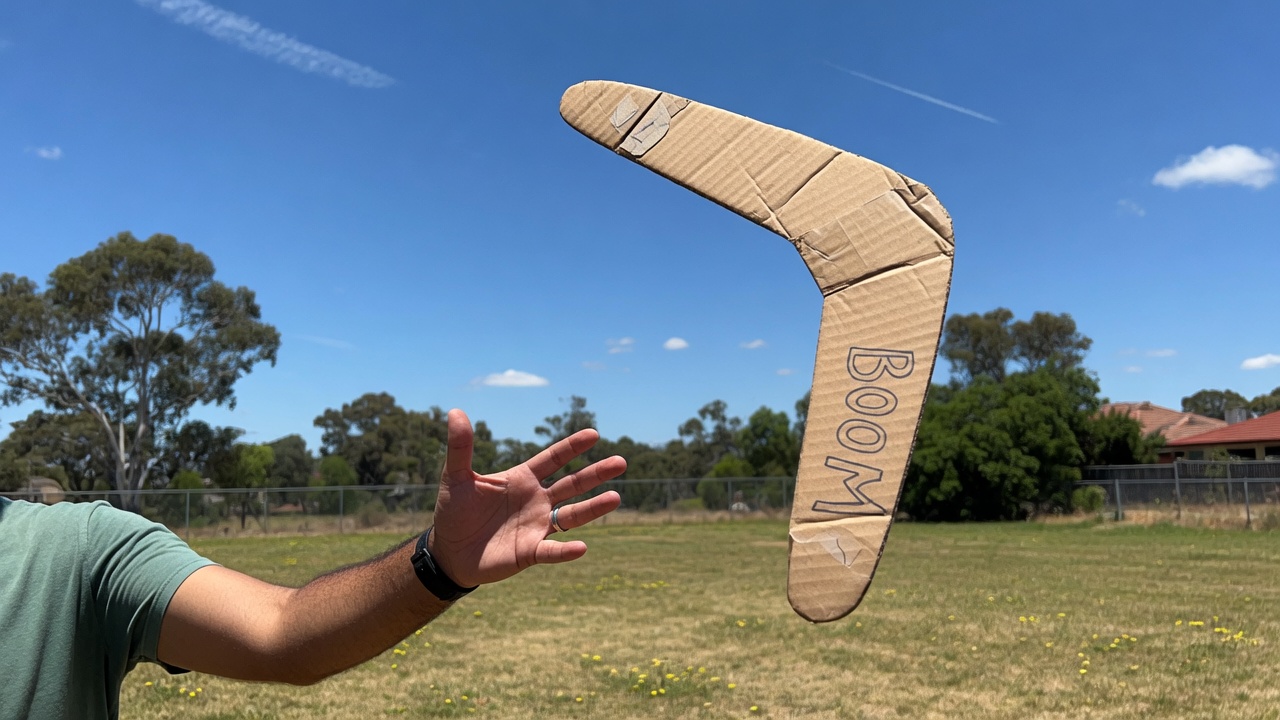
I was roaming for a break and landed on ScienceToyMaker.org. Messy workshop vibe, full of kinetic DIY projects. One project jumped out: the "World Wide Boomerang." A simple V-shaped piece cut from cardboard that actually flies in a circle and comes back to you.
I downloaded the pattern, cut one out (took 10 minutes with scissors and tape), and threw it in the hallway. It looped. Badly at first, then better with practice. That sent me down the rabbit hole.
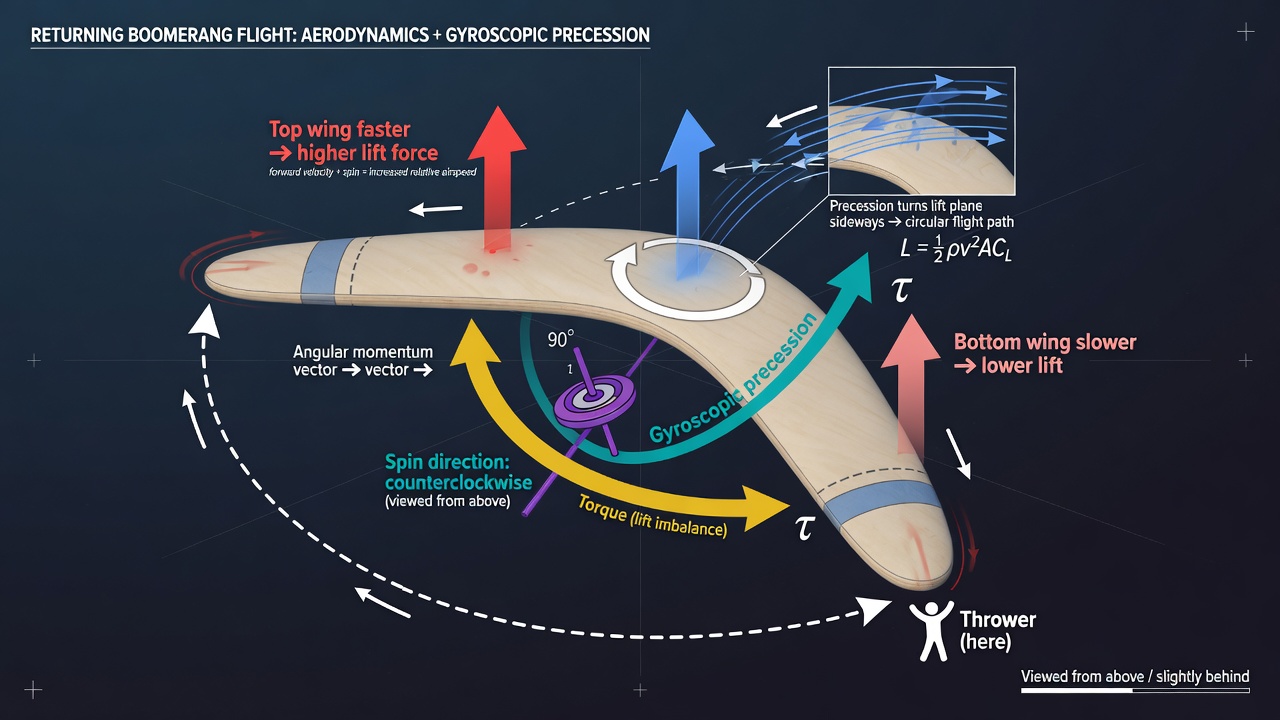
A boomerang returns because of two things working together: lift from its airfoil shape and gyroscopic precession from the spin.
When you throw it (almost vertically, spinning), the arm at the top of the spin is moving faster through the air than the bottom arm. Faster air speed = more lift on the top arm.
That unbalanced lift creates a torque. The torque doesn't flip the boomerang — it precesses the spin axis. The whole thing slowly turns so its "nose" points more and more left (for a right-handed throw). The path curves into a circle.
It "lies down" as it climbs, then glides back as speed drops. A typical flight is only about 8 seconds but looks longer and more magical.
Sources that made it click: HyperPhysics has clean vector diagrams. The Australian Museum explains the "upper arm faster" intuition simply.
The World Wide Boomerang from ScienceToyMaker is cardboard, no fancy materials. There's even a no-glue version with a wing nut. Kids and makers around the world have made variations: indoor paper ones, foam, 3D printed.
It's the kind of project that rewards fiddling — tweak the dihedral (the slight V bend), the throw angle, the spin. Suddenly it snaps back instead of crashing.
Here's a tiny self-contained simulation of the curved path. Not perfect physics, but it captures the loop from precession.
Throw angle, spin rate, and that slight dihedral matter. The sim just loops the precession idea.
It's low-tech magic. Cardboard + physics = something that feels alive when it comes back. The site is full of these: walkalong gliders, stomp rockets, things that invite "what if I change this?"
If you have cardboard and 10 minutes, try the pattern. The first throws will be terrible. Then one will curve and you'll grin like an idiot.
That's the rabbit hole worth falling into.