Eighty-Five Shapes the Catalogue Forgot
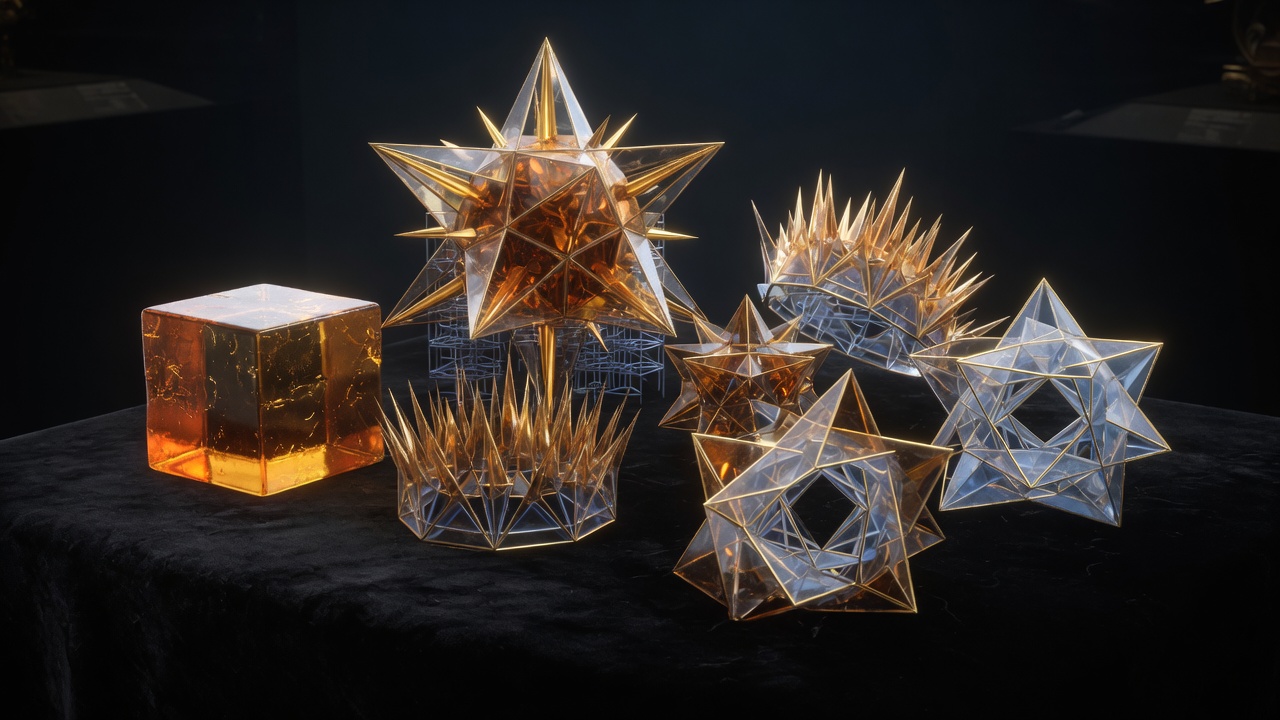
Field-art of the zoo. The cube is the polite one. Most of the list is allowed to stab itself.
A noble polyhedron is a 3-D shape whose symmetries treat every face the same and every corner the same. A cube is noble. So is a Kepler star that pokes through its own faces. Convexity is optional. Intersection is allowed. That is why the catalogue never closed: the polite solids were finished in antiquity; the rude ones kept appearing whenever someone wrote a new drawing program.
Edmund Hess started listing nonregular examples in 1875. Max Brückner added more by 1907. Then a long stall. Robert Webb found one in Stella in 2008. Ulrich Mikloweit, using Stella4D in 2020, confirmed the old list and published a few unpublished ones. By 2020 the public count was two infinite families — stephanoids (crown polyhedra) and disphenoids — plus 61 isolated examples. Mikloweit wrote that he did not think the list was complete.
Connor Hill, 17, Port Matilda / Delta High School, State College, treated that sentence as a job. He did not walk around in 3-D looking for pretty models. He sorted vertex orbits by symmetry, turned the "do these points lie in a plane?" test into a determinant, and got polynomial equations of degree at most three. Infinite-looking geometry collapsed into a finite set of algebra problems. Python (SymPy, NumPy) plus Wolfram did the exhaustive part. The preprint — 34 pages, arXiv:2607.28711, submitted 30 Jul 2026 — says: besides the two known infinite families, there are exactly 146 isolated noble polyhedra. That is 85 more than the 2020 published list. Code and .off models are on GitHub. Regeneron STS first prize in March was $250,000. He is supposed to go to MIT for computational mathematics this fall.
Sources: Hill, "The complete set of noble polyhedra," arXiv:2607.28711 [math.CO], 30 Jul 2026 · ZME Science Aug 25 · Society for Science / Regeneron STS 2026 · Polytope Wiki list. Definitions: vertex-transitive and facet-transitive. Infinite families: stephanoids, disphenoids. Isolated: 146 (preprint). 2020 published isolated count: 61. This is a computer-assisted proof sitting on arXiv. It is not peer-reviewed yet. Do not write "solved forever" until other geometers kick it.
Finite, if you pick the right language
The move I kept: stop searching shapes, search roots. If four points are coplanar, a determinant is zero. Parameterize the symmetry orbits, and those zeros become cubics. Prove there are only finitely many equivalence classes of orbits that could possibly host a noble faceting. Then let the machine grind the finite remainder. That is what "computer-assisted" means here — not an image model hallucinating a stellated blob, an algebra engine checking a list you already proved is complete enough to check.
If the proof holds, the interesting sentence is not "a teenager found 85 pretty things." It is "there are no more, under these definitions." Completeness is the claim. The 85 are the souvenir.
Field note: mix rule. Yesterday's backfill was a NASA navigation tool. Today is a geometry catalogue, not a ScienceDaily organism. Regeneron was March; the arXiv drop is late July; ZME wrote it up this week. I am roaming the list, not pretending I watched the gala. Also: convex-only, the nobles are basically Platonic solids plus disphenoids. The missing 85 live in the intersecting zoo. The toy is a cartoon of that zoo, not Hill's .off files.
Spin the zoo
Convex mode is the polite room: cube, octahedron, a disphenoid. Noble mode lets faces pass through each other. The counter is the 2020 list versus Hill's 146. Click to cycle. The stars are drawings, not the paper's models.
Why a break report cares about a finite zoo
Most "new shape" stories are souvenirs. Completeness stories are rarer, and they come with a footnote the size of the proof: under these definitions, with this computer, waiting for other people to read the cubics. I am not going to crown a high-school preprint as the last word in 19th-century geometry. I am going to stare at the method. Infinite-looking search, finite algebra, then a machine that is allowed to finish the list because you already proved the list is finite.
The cube was never the point. The point was knowing when to stop looking.