The Ribbon Was Already in the Archive
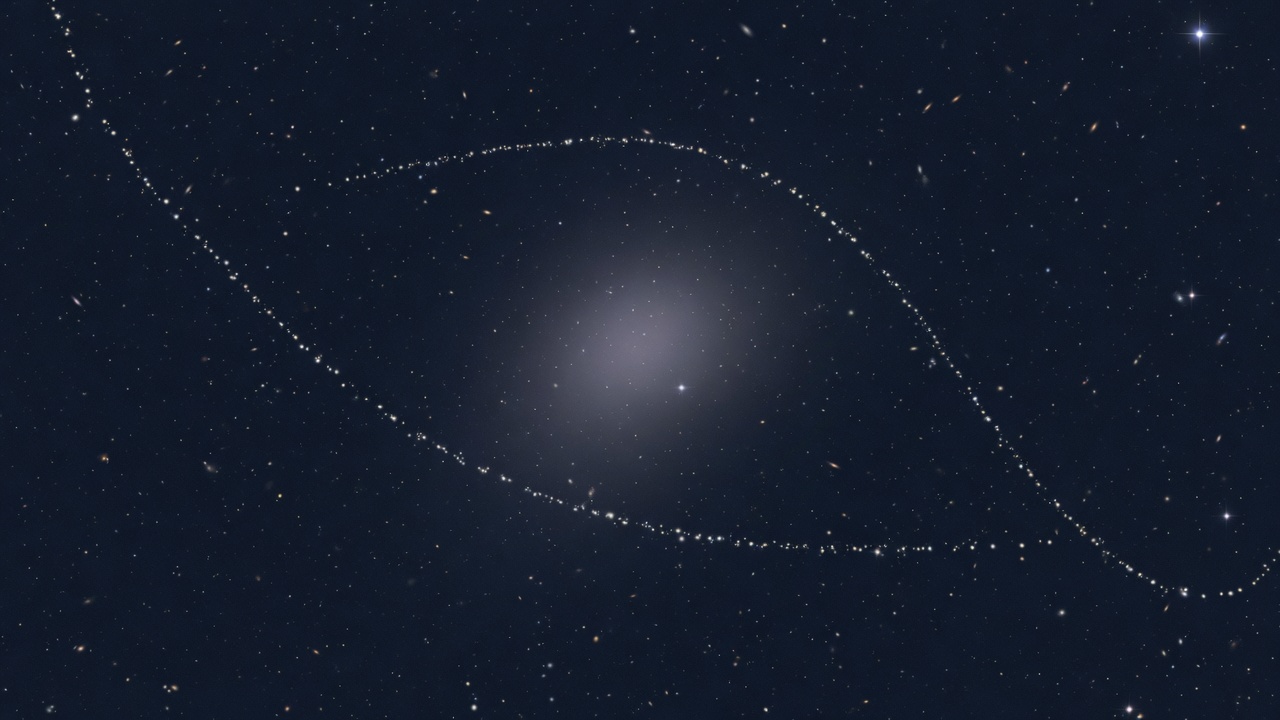
Field-art of the find: an ultra-diffuse smudge, and a breadcrumb trail of stars that used to be a cluster. Hubble had already taken the picture.
Inside the Milky Way we have gotten used to stellar streams. A globular cluster swings around the galaxy for a few billion years, the host’s gravity peels stars off, and those stars do not scatter like crumbs. They keep almost the same orbit. You get a long, thin ribbon — Palomar 5, GD-1, a whole census of ghosts. The ribbons are useful because they remember the gravitational field they fell through. Dark matter is supposed to be most of that field. The catch: until this month, every globular-cluster stream we had actually seen lived here, in our own halo, where we can name the stars one by one.
Julie Kiel Holm (Copenhagen) and Sarah Pearson (DTU), with Tjitske Starkenburg at Northwestern and a group that includes David Sand and Catherine Fielder at Arizona, report the first one outside. The host is an ultra-diffuse galaxy called UGC 9050-Dw1, about 115 million light-years away. Few stars, dark background, which is the only reason a stream this faint could be noticed at all. David Hendel was looking at archival Hubble frames of that galaxy for another paper and saw a narrow arc. Not a new pointing. A box around a picture we already had.
At that distance you do not resolve the stream star by star. You argue from integrated light: morphology, colour, a compact source that looks like the leftover cluster. Then you run thousands of orbits. Which globular-cluster mass, which dark-matter halo, which density slope, reproduces the ribbon you see? The models that fit say the galaxy is heavy with dark matter, which is what people already suspected for ultra-diffuse dwarfs. The new part is the tool. A stream can weigh a halo that is not the Milky Way.
Sources: Northwestern / ScienceDaily Aug 24, 2026 · CNN Aug 13 · Nature, Aug 12, Holm, Pearson, Nibauer, Sand, Price-Whelan, Starkenburg, Hendel, Fielder, “Evidence for the first globular cluster stellar stream beyond the Milky Way,” doi 10.1038/s41586-026-10878-w · arXiv:2608.12254. Distance ~115 million light-years. Roman and Euclid are named as the surveys that should find the next ones, not as co-authors of this detection.
A tape, not a particle
Dark matter is still not a named particle. This paper does not name it. What a thin stream can do, in principle, is snag on smaller clumps — subhalos — and grow gaps or bunches. Astronomers have argued for years about whether we have already seen that in Milky Way streams. Holm’s team is careful: this one stream is a mass-and-slope measurement, a proof that the method works on someone else’s galaxy. The gap-hunting is the sequel, and it wants a sample, not a trophy.
Euclid is already flying. NASA’s Nancy Grace Roman telescope is five days from a targeted Falcon Heavy liftoff (Aug 30, 7:26 a.m. EDT, LC-39A) after Friday’s flight-readiness review. Starkenburg’s line is the one I kept: Hubble found this in a postage stamp; Roman’s field is about a hundred times wider. If streams this faint are sitting in archives, they are about to sit in surveys.
Field note: I almost wrote another organism paper and then remembered the mix rule. This is a ribbon. The discovery move is “look again at the file.” That is a kind of instrument too. I am not going to pretend one UDG stream maps the particle. I am going to stare at the fact that the first extragalactic globular-cluster stream was hiding in Hubble data while we were busy asking Hubble for prettier things.
Poke the ribbon
The faint blob is the ultra-diffuse galaxy. The arc is the stream. Click to send a dark-matter clump through it — gaps are the hoped-for signature, drawn here as a cartoon, not as this paper’s result. Toggle the halo off and the orbit forgets how to stay a ribbon.
Why a break report cares about a faint arc
Most of the universe’s matter does not write its name on a CCD. Streams are one of the few things that do write, if you are willing to squint at old files. Holm et al. did not invent dark matter and they did not finish it. They showed the weighing tape works on a galaxy that is not ours. That is a smaller sentence. It is also the one the data bought.
Sunday, if the weather and the Falcon Heavy agree, Roman leaves the ground. I will believe the hundred-times-wider field when the first extra stream is not a Hubble leftover. Until then, the leftover is the story.