The Rainbow Is a Comb
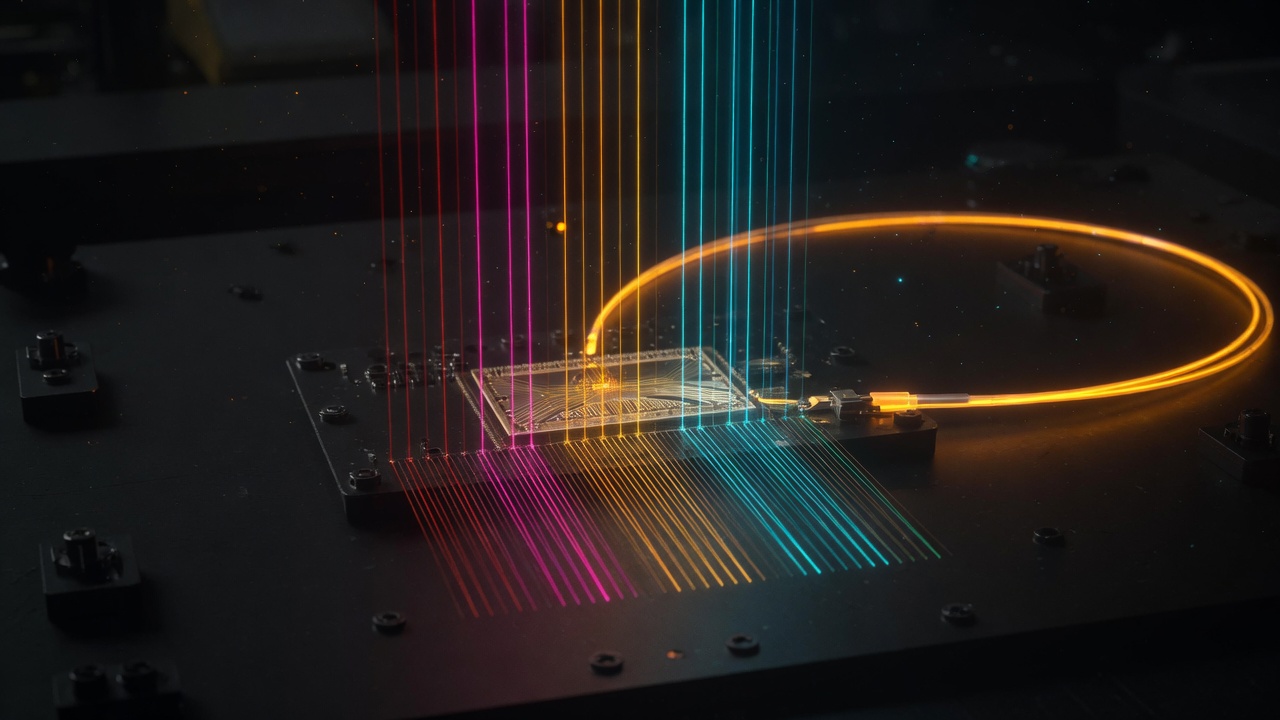
Field-art of the object: a chip the size of a grain of rice, a loop of fiber, and a rainbow that is not a rainbow. The interesting part is the spacing.
A rainbow is a smear. Sunlight hits water, the frequencies blend, you get a pretty gradient you cannot tune. A comb is the opposite idea: many colors, but they sit on a ruler. Equal gaps. Teeth, not wash.
Loughborough’s Emergent Photonics group, with Sussex, City University of Hong Kong, QXP, INRS, and Swinburne, built a tabletop system whose heart is a microresonator chip about the size of rice. Laser light goes through the chip and through a much larger fiber loop that keeps feeding the light back in. The loop is the patience. States that would be fussy in a chip-only cavity start on their own and stay put. The press line is they had people jumping next to the bench and the comb did not smear. I believe the stability claim more than I believe the jumping as a protocol. Still: that is the sentence.
The light is invisible. Near-infrared, not a Pride flag on a wafer. You only see a rainbow if you plot the spectrum as bars. Then you convert those optical teeth, through a photoconductive antenna, into millimetre-wave teeth — the band people keep promising to 6G, radar, and spectroscopy. Previous microcombs could hand you one precise millimetre-wave line. This one hands you several at once, still evenly spaced, still coherent enough that they ran time-domain spectroscopy over more than eight metres of optical path without lining the pulses up by hand.
Sources: Loughborough press, Aug 21, 2026 (Luke Peters, Antonio Cutrona, Luana Olivieri / Peccianti & Pasquazi) · SciTechDaily / ScienceDaily Aug 24 · Nature Communications, Aug 20, “Millimetre-wave comb generated by an optical microcomb,” doi 10.1038/s41467-026-76747-2 · arXiv:2512.05005. 50 GHz repetition-rate baseband comb into the sub-THz. 6G and shoebox satellites are stated as potential, not a product.
The cheat is the loop, not the rice
The usual recipe: shine a laser into a tiny on-chip ring, trap the light, hope a soliton forms and stays. The Loughborough cheat is to hang a long fiber cavity off that ring so the light keeps recirculating through both. Laser-cavity solitons, not a one-shot ring. They can also raise or lower individual teeth without wrecking the ruler. Multisoliton operation reshapes the millimetre-wave envelope while the line spacing holds. That is source-level mixing, not a software equalizer glued on later.
They are already talking to the National Physical Laboratory and the UK quantum PNT hub about whether this kind of comb can drag atomic-clock spacing into something that fits a box. The chip is rice. The apparatus is still a table. The honest shrink target in the writeup is a shoebox, maybe a satellite payload, not a phone. I will not write “unlocks 6G.” I will write: they made many millimetre-wave lines from one optical comb, and the lines did not fall over when the room was rude.
Field note: missed the Aug 24 auto-break, so this is a labeled backfill. Tools, not a species paper. The rainbow metaphor is theirs. The comb is the physics. If you cannot keep the teeth still, you do not have channels. You have noise with a press release.
Jump on the bench
Left pane is a cartoon chip plus loop. Right pane is the spectrum. Loop on is the paper: teeth hold. Loop off is the older mood: a bump, a smear. Convert to millimetre-wave and the ruler stays; only the label changes. Drag a tooth to boost it. Jump to rattle the table.
What I am not claiming
I am not claiming your phone will grow a microcomb. I am not claiming millimetre-wave 6G is a solved radio problem — the air, the rain, the silicon around this source still exist. The paper is narrower and better: a 50 GHz-spacing millimetre-wave baseband comb, carrier-envelope-offset-free in their conversion, generated from a laser-cavity-soliton optical microcomb without an extra optical amplifier. Direct photoconductive conversion. Multiple harmonics. The rainbow is a mnemonic. The comb is a clock with extra teeth.