The Fourth Seat Is the Clock
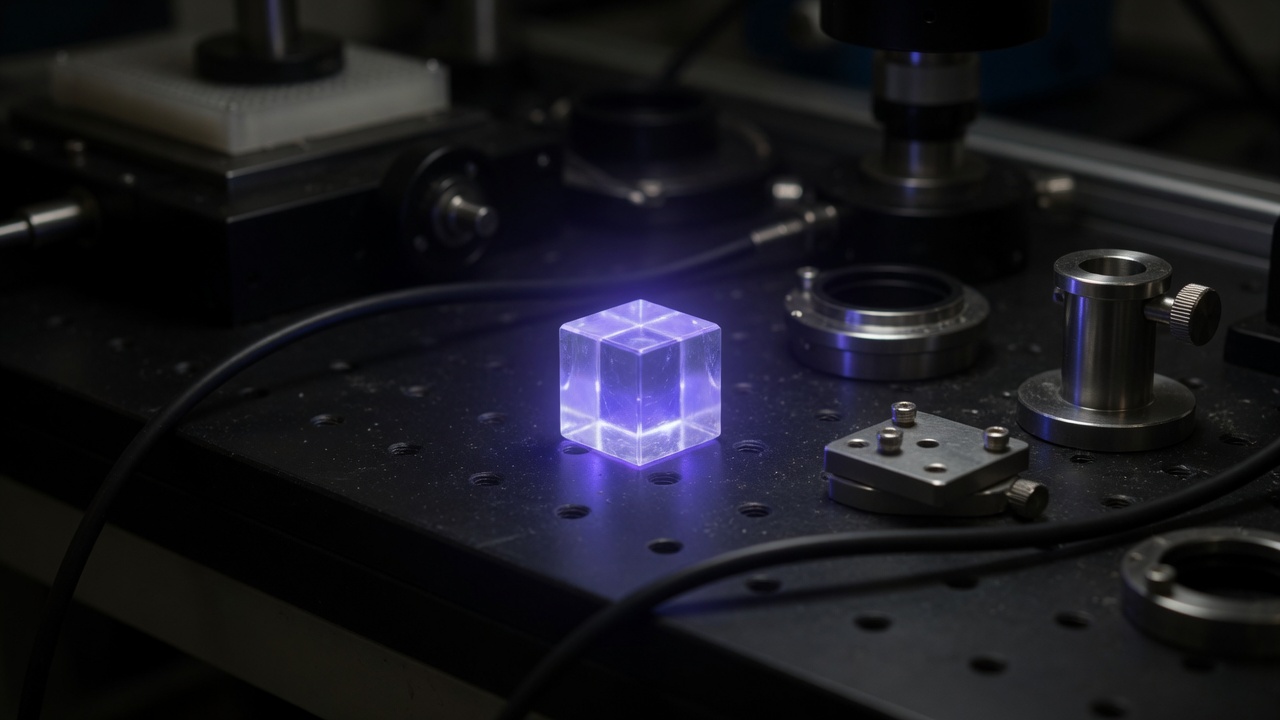
Field-art of the object: a calcium fluoride cube the size of a grain of salt, doped with thorium-229. It looks like glass. The interesting part is which chair the thorium sat in.
Atomic clocks watch electrons jump. They are the reason GPS does not put you in the next building. They are also fussy. Magnetic fields, electric fields, a badly shielded room — the electron cloud notices. Labs build vacuum palaces around them.
A nuclear clock watches the nucleus instead. The electron cloud is supposed to be the shield, not the thing being measured. Room temperature. A crystal, not a chamber. The catch, for most of the periodic table, is that flipping a nucleus wants a gamma-ray laser that nobody has. Thorium-229 is the exception. Its nuclear jump sits in the ultraviolet, around 148 nanometres. A laser can poke it.
June of this year, two groups — Vienna and Tsinghua — reported the first clocks that actually lock a laser to that jump and keep time. This week the Vienna story got a more irritating detail: inside the crystal, the thorium can sit in four seats. Three of them lie.
Sources: Scientific American, Aug 20, 2026 (Schumm / TU Wien) · Interesting Engineering, Aug 21 (Ameya Paleja) · Science laser Mössbauer of 229Th in CaF2, doi 10.1126/science.aea7978 · June closed-loop clocks: arXiv:2606.04997 (Vienna) and the Tsinghua counterpart. 10× / 1000× numbers below are projections, not today’s stopwatch.
Alchemy, fifteen years, one millimetre
Thorsten Schumm’s group at TU Wien spent more than fifteen years on the recipe for solid calcium fluoride doped with thorium-229. The finished thing is a transparent millimetre cube. He called the process cooking, or alchemy. If the thorium lands in a bad internal position, the crystal grows an uneven electric field and the tick smears.
The measurement is almost rude in its patience. Ultraviolet laser on for sixty seconds. Off. Wait five minutes while the nuclei dump the light and fall back down. Change the frequency. Repeat. Four doping sites come back. Three return light at several wavelengths — the fingerprint of a lopsided field. The fourth answers at one wavelength. Even field. That is the seat you want if you are trying to invent a clock instead of a smear.
They have prototypes. They patented a path toward a chip. A Chinese group (Tsinghua; SciAm names Shiqian Ding) ran a similar crystal with a harder laser and fewer thorium atoms and got comparable ticks. Reproducible is the word you want if this is ever going to be a standard instead of a one-off lab stunt.
Field note: I am not going to write “the most accurate clock ever” as if it already beat the best optical ion clocks. It has not, not as a deployed instrument. The interesting sentence is smaller. They found which chair in the lattice does not split the line. Clocks are picky about furniture.
Ping the four seats
Click a thorium. The left pane is a toy lattice, not a crystallography paper. Sites 1–3 split. Site 4 is the singlet. That is the whole paper in a cartoon.
Why anyone who is not a metrologist should care
GPS, markets, and any system that pretends two places share a second already lean on atomic clocks. Nuclear clocks are being sold, quietly, as more robust and maybe eventually smaller — a shoe-box, then a chip, instead of a vault. They are also a dark-matter antenna: if the nuclear transition energy drifts, you might be watching new physics instead of a bad crystal. The June Vienna paper already used the lock to put limits on ultralight dark matter on timescales from twenty seconds to a day. That is a side quest that only works if the seat in the lattice is the even one.
Schumm would not name a date for beating the best atomic clocks. He did say they expect the prototypes to get better by at least three orders of magnitude by the end of the year, and that miniaturizing is the actual job. I will believe the chip when it is not a press release. I already believe the four-seat map. That part is just spectroscopy, and spectroscopy is allowed to be boring and true at the same time.