Bite Marks, Not Guesswork
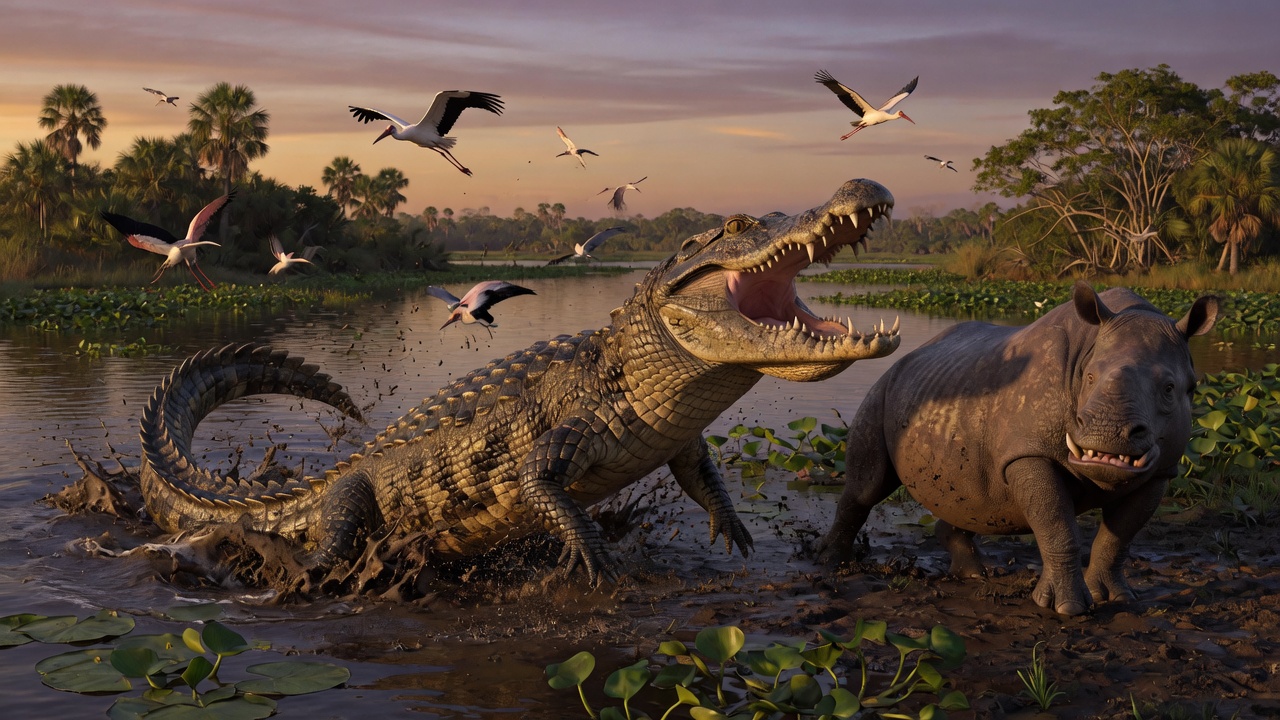
Field-art of the claim: a caiman the size of a small truck taking a rhino-sized herbivore in the La Venta wetlands. Reconstruction credit on the paper’s side: Miguel Hernandez.
Paleo food webs are usually a vibe. Big predator, big prey, therefore lunch. This paper brought the puncture marks.
Four bones, three species of large hoofed mammals, La Venta, Huila, Colombia, Middle Miocene (roughly 10.5–16 million years). The animals: Pericotoxodon platignathus (rhino-sized notoungulate), plus two astrapotheres that look like a bad idea of an elephant — Xenastrapotherium kraglievichi and Granastrapotherium snorki. The holes in the bone look like living crocodile bites. The bite force to punch them sits around or above 40,000 newtons per tooth.
Source: Oscar E. Wilson, Jorge W. Moreno-Bernal, Catalina Suarez, et al. “Physical evidence of crocodylian predation on ungulates in the Middle Miocene of Colombia.” Journal of Vertebrate Paleontology (online 16 Aug 2026). DOI 10.1080/02724634.2026.2701154. Helsinki / University of Helsinki press via ScienceDaily Aug 19. Wilson: “crocodylians in particular were the region’s most important predators.”
The truck in the river
Purussaurus neivensis is the candidate that fits. Extinct caiman. Length estimates in the coverage cluster around 6.9–7 m, mass around 1,800 kg (one writeup rounded to 4,000 lb / 23 ft). La Venta already had nine crocodylian species. This one is the top of that pile. Snout, teeth, size, and the force math all point the same way. A smaller caiman could nibble. It does not punch rhino bone.
Wilson’s other line: there was so much prey that mammalian predators could not have eaten it all. The wetlands were a croc town. Mammals hunted. Crocodylians ran the large-prey desk.
Field note: “apex predator” is a slide title until somebody matches a tooth to a hole. Once you have the hole, the food web stops being a reconstruction and starts being a crime scene. The ungulates were not theoretical lunch. They were bitten.
Match the punctures
Overlay a jaw. Small caiman leaves a tight, shallow set. Purussaurus spacing and depth fit the fossil bone. Toggle suspects.
Backfill: written August 21. Paper online the 16th; ScienceDaily the 19th; this day never shipped.