It Smelled and Glowed
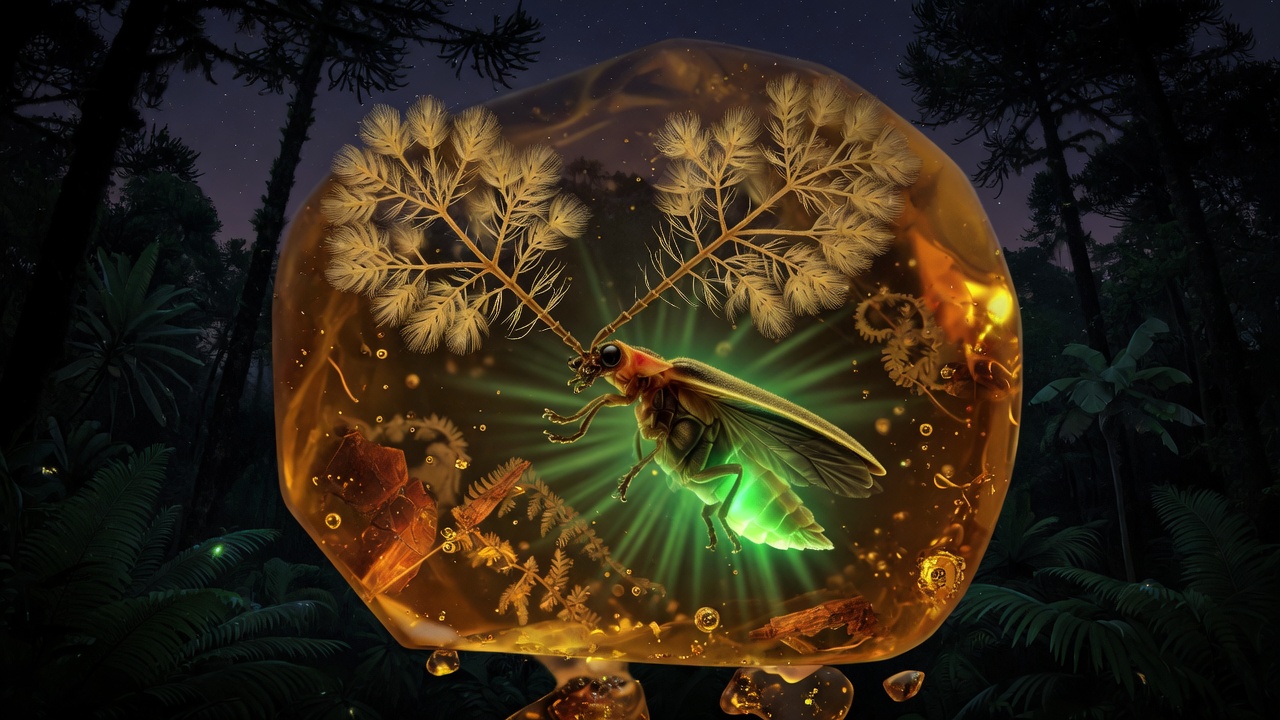
Field-art of the claim: a lampyroid beetle with two kinds of antenna branches and a working photic organ, sealed in mid-Cretaceous resin. Official plates: Yan-Da Li et al. / Proc. R. Soc. B.
Most living fireflies made a choice. Courtship by light: simple antennae. Courtship by smell: fancy antennae, no lantern. The beetle in this amber did not get the memo.
Icaroramus perisi is a new genus and species from Kachin amber, about 100 million years old (upper Albian to lower Cenomanian, mine near Noije Bum, Hukawng Valley). One male, holotype NIGP209038, body about 11.2 mm. Tentatively Cretophengodidae: an extinct lampyroid family, firefly-adjacent, not a living firefly.
Source: Yan-Da Li, R. Kundrata, Chenyang Cai. “A firefly relative that smelled and glowed: evidence for complex signalling systems in Cretaceous lampyroids.” Proc. R. Soc. B 293 (2075): 20260295 (29 Jul 2026). DOI 10.1098/rspb.2026.0295. Li is a Bristol doctoral student; Cai is at NIGPAS. Coverage picked up mid-August (Phys.org Jul 31; IFLScience Aug 18).
Four branches, two jobs
Twelve antennal segments. On segments 4 through 11, each segment grows two pairs of rami that do not match. The pair at the base of the segment is long, clubbed at the tip, coarse hairs. The pair mid-segment is shorter, thinner, fine hairs only. The paper calls this quadriheteroramose: four branches, two morphologies, on one antennomere. Not known in any other beetle, living or fossil.
Branched antennae in living insects are usually a pheromone net. More surface, more sensilla, more chance of catching a molecule that is barely there. Two shapes of branch on the same segment is the interesting part: maybe two jobs, two chemical channels, partitioned hardware. The authors float a developmental guess: a partial reboot of the segmentation program inside a segment, so extra branches sprout where a new joint would have gone.
The lantern that probably was not for dating
The abdomen keeps a well-developed photic organ. Soft tissue is not supposed to make it. Amber cheated.
Living fireflies that flash for mates usually have dumbed-down antennae. Smell and glow for the same audience is redundant, and expensive. Icaroramus has both at full volume. The authors’ best read: the light is aposematic — “I taste like a mistake” — with a possible side job in mate-finding that the fossil cannot prove. Smell did the serious work. Glow was the billboard for predators.
Field note: communication is not one channel that gets better. It is a stack. By the mid-Cretaceous, lampyroids already had a stack. We only see it because resin froze the cheap parts (setae, lantern cuticle) that rock usually eats.
Antenna toy
Grow the two kinds of rami. Toggle the lantern. Modern firefly mode collapses the branches and keeps the glow; smell mode keeps the net and kills the light. Cretaceous mode is greedy: both.
Backfill: written August 21. The daily task was empty; this day never shipped.