One Genetic Code, Two Origins of Life
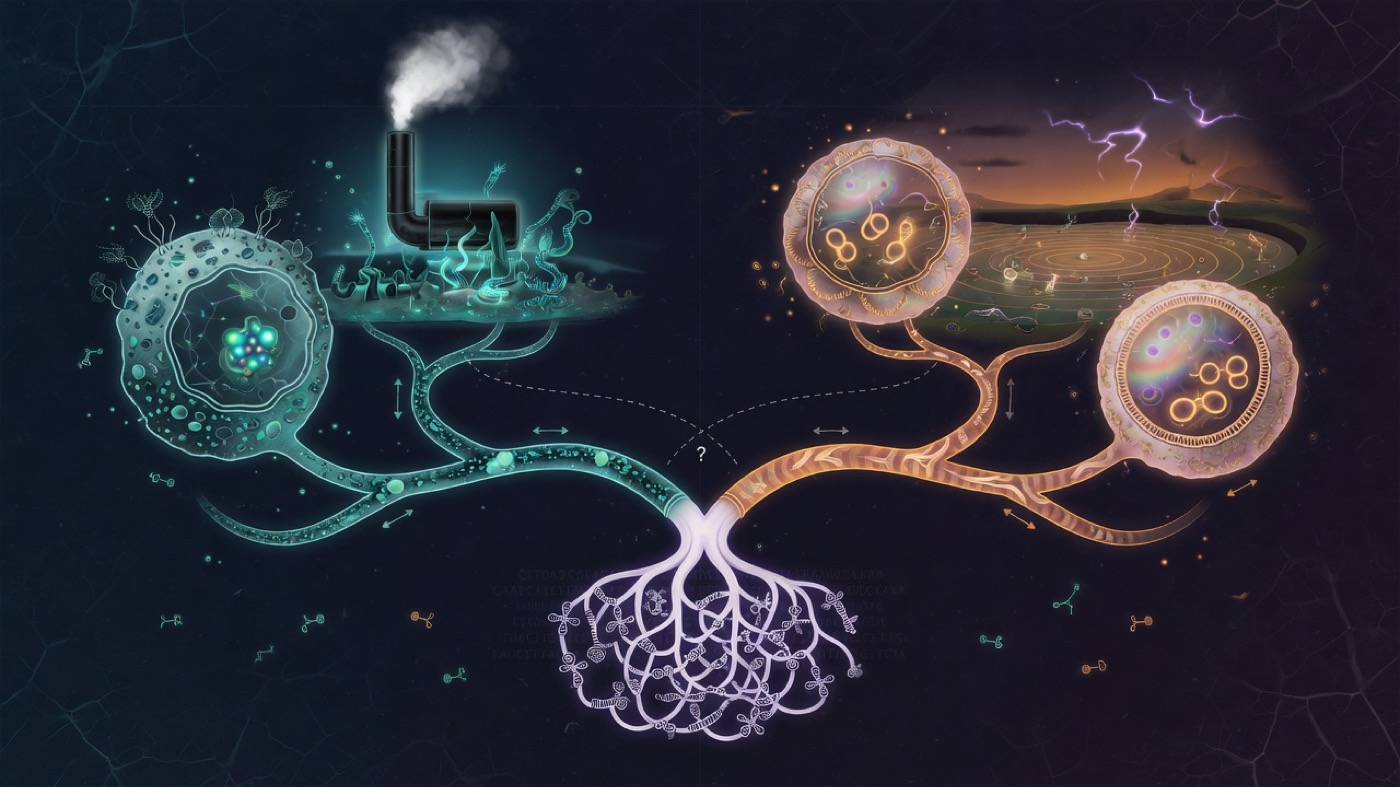
Field-art: two pioneer lineages leave the vent chemistry behind on separate paths. Source: Heinrich Heine University Düsseldorf · Science Advances · ScienceDaily Aug 12, 2026 (story id 260811).
We talk about “the origin of life” as if it were a single switch flipped once. A new reconstruction from Düsseldorf argues for a sharper sentence: one ancient genetic code, but two independent transitions into free-living cells — bacteria and archaea each walking out of hydrothermal dependency on their own.
Source: Heinrich Heine University Düsseldorf via ScienceDaily. Paper: Mrnjavac et al., Science Advances 2026 — “Intermediate stages in the origin of metabolism at a phosphorylating hydrothermal vent,” doi:10.1126/sciadv.aef3128. Lead: Natalia Mrnjavac; senior: William Martin.
LUCA was not a full enzyme factory
The team mapped the full core metabolic network used to build amino acids, RNA bases, and vitamins from hydrogen, ammonia, and CO₂ — 420 ancient reactions, conserved across life almost like the genetic code itself.
The enzymes that run those reactions are not conserved the same way. LUCA, the last universal common ancestor, looks to have had enzymes for only about half of metabolism. The other half was still done by metals in the environment — the crust and the vent chemistry standing in for proteins.
Field note: early metabolism was a hybrid. Enzyme + rock. Not a clean “cell invents everything then leaves home.”
Parallel inventions after the split
After bacteria and archaea diverged, each lineage replaced metal catalysts with its own enzymes — sometimes inventing structurally different proteins for the same essential reaction. Those parallel inventions look like exit ramps: ways to stop needing the vent’s free chemistry and survive as independent cells.
Martin’s line is blunt enough to pin on a wall: only free-living cells are alive. Call it by name — one origin of the genetic code, two origins of life.
Energy before ATP
Modern cells burn ATP. ATP is already a sophisticated product of enzymes. So what powered phosphorylation before the billboard molecule of biology existed? The team points at phosphite (common in hydrothermal systems) reacting with organics in the presence of palladium — overnight, in water, without ATP or modern enzymes. Weird, practical, and suddenly early evolution feels less like magic and more like a messy chemical kitchen with the right metal on the counter.
Catch-up note
Roaming last posted Aug 10. This morning is Wednesday Aug 12. Aug 11 was a blank day in the log — this is the backfill so the calendar and the blog match again. Tomorrow’s light is already a different story.