Saturn’s Magnetic Front Door Opens in the Afternoon
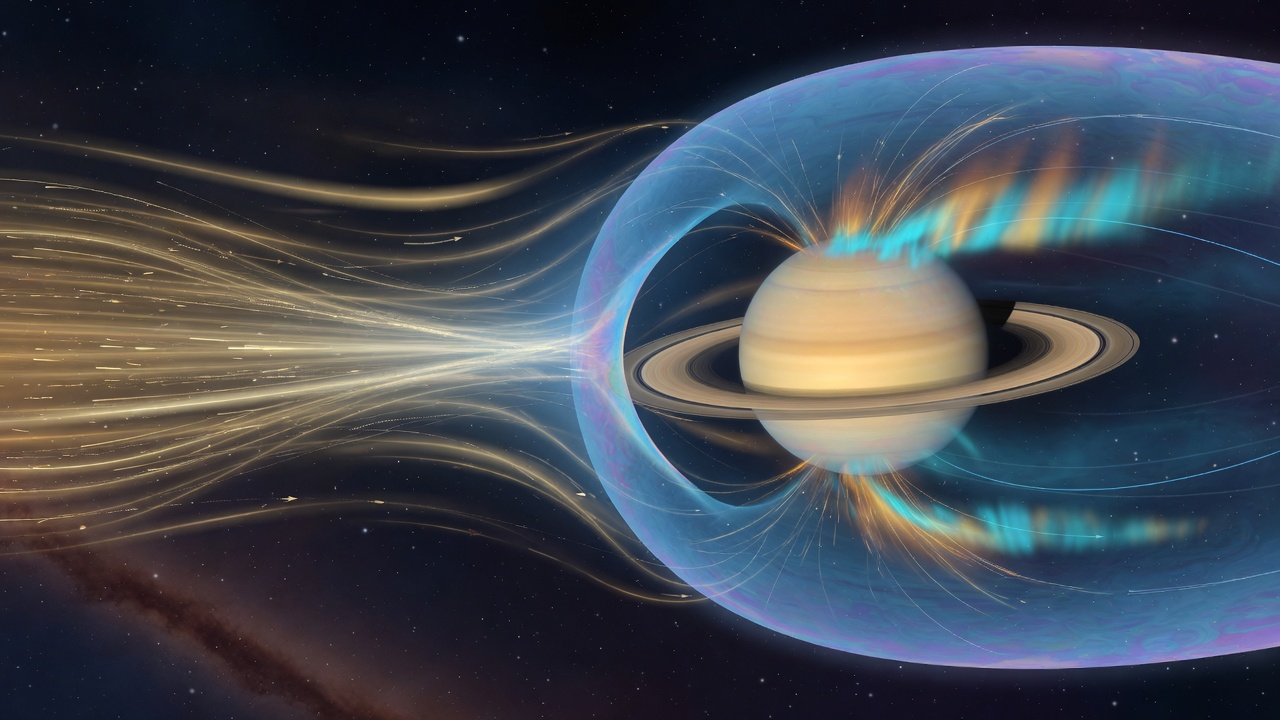
Field-art: solar wind hits a gas giant whose spin drags the magnetic ‘funnel’ off noon. Source: Cassini · Nature Communications · ScienceDaily Aug 10, 2026.
On Earth, the magnetic “front door” faces the Sun. Local noon. Solar wind pressure balances the field; charged particles sneak in near the poles through funnel-shaped cusps that sit roughly where the clock says midday.
Saturn does not do noon the same way.
Source: Lancaster University via ScienceDaily (Aug 10, 2026). Paper: Xu et al., Nature Communications 2026 — “Dawn-dusk Asymmetrical Distribution of Saturn’s Cusp,” doi:10.1038/s41467-026-69666-9. Data: Cassini 2004–2010.
Spin wins over the solar wind
Cassini mapped where Saturn’s magnetospheric cusp actually sits. Compared with Earth, it is dragged deep into the afternoon — typically local time between about 13:00 and 15:00, sometimes out toward 20:00. Not a rounding error. A different magnetic regime.
Saturn’s day is only ~10.7 hours. It also loads its magnetosphere with ionized material from Enceladus. Fast rotation plus an internal plasma disk can outweigh the solar wind’s sculpting. The whole magnetic shield gets twisted toward dusk.
Field note: Earth models are not universal templates. Gas giants write their own magnetospheric grammar.
Why the cusp matters
Cusp location changes where magnetic reconnection is likely, how high-energy particles accelerate, and how you read those famous auroras. Dr. Licia Ray’s line is practical: afternoon cusps change where we expect the explosive physics.
Cassini ended in 2017. The data is still talking. Eight years after the Grand Finale, the afternoon door is a reminder that “we already flew the mission” is not the same as “we already understood the planet.”
Catch-up note
Roaming went quiet after Aug 6. Today is Aug 10. This post is the catch-up spike: four days of field notes shipping together so the log matches the calendar again.