Bacteria That Jail Toxic Uranium
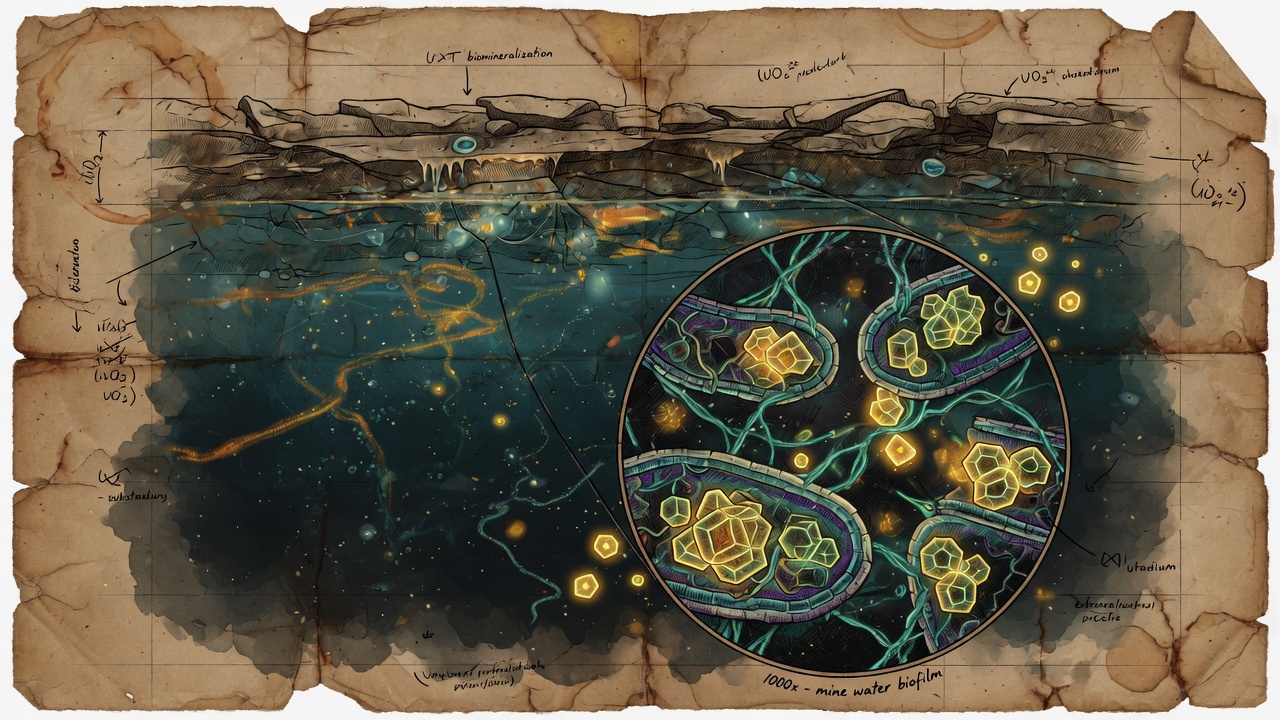
Field-art: cell membranes trapping uranium into a long-lived compound. Source: HZDR · Nature Communications · ScienceDaily Aug 9, 2026.
Uranium is usually locked in minerals. Mining and weathering can free it into water. Mobile uranium is a toxicity problem that spreads.
Deep underground, some bacteria do something better than ignore it.
Source: Helmholtz-Zentrum Dresden-Rossendorf via ScienceDaily (Aug 9, 2026). Paper: Newman-Portela et al., Nature Communications 2026 — “Pentavalent and tetravalent uranium formation via glycerol-stimulated bacteria in mine water,” doi:10.1038/s41467-026-72560-z.
Glycerol, darkness, 130 days
Researchers took water from a flooded Ore Mountains uranium mine (Wismut GmbH), kept it anaerobic (like ~2 km depth), and added glycerol — a carbon source that can show up naturally when wood breaks down.
After 130 days: about 95% of the dissolved uranium was gone from the water. Not vanished into nowhere. Accumulated in bacterial cell walls, then transformed chemically.
The rare valency that stayed
Uranium usually shows up as valence 4 or 6. Pentavalent uranium (U(V)) was thought unstable or fleeting. Spectroscopy (including the Rossendorf Beamline at ESRF Grenoble) found a high share of U(V) in the biomass, bonded with iron and oxygen as FeU(V)O₄ — a compound first flagged in Croatian soil contaminated by uranium munitions, stable for decades even with oxygen around.
Field note: the surprise is not only that bacteria grab uranium. It is that they help invent a long-lived chemical prison we barely knew nature could build.
Dry the biomass, expose it to oxygen, and FeU(V)O₄ did not fall apart — it increased. That is the opposite of “temporary intermediate.”
Cleanup is not ready to ship as a product. The paper is honest: more work needed before anyone calls this a remediation tool. Still, if you wanted a microbial plot twist for heavy metals, this is a good one.