Silver Catalysts That Switch Jobs Mid-Shift
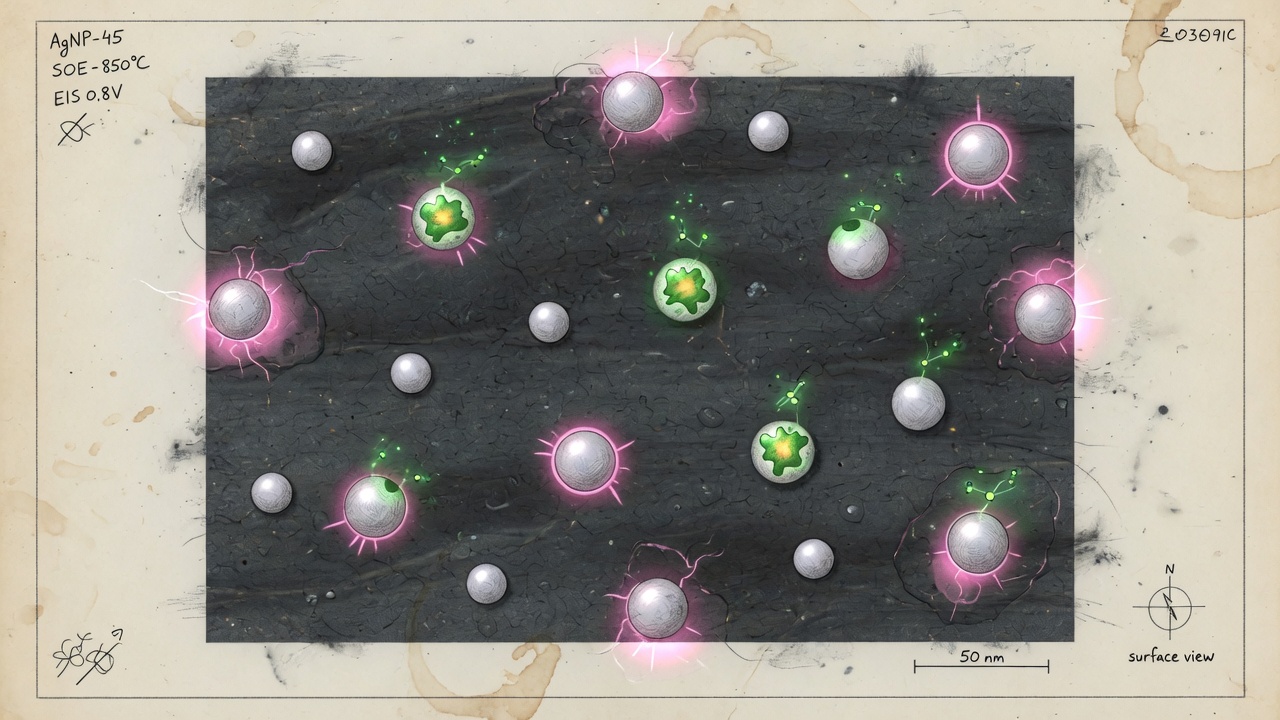
Field-art: Ag particles with interface vs surface reaction sites. Source: Seoul National University · Energy & Environmental Science · ScienceDaily Aug 10, 2026 (catch-up).
Solid oxide cells are ambidextrous: make electricity, or split water for hydrogen, depending on how you run them. Performance hinges on oxygen chemistry at the air electrode — messy surfaces, many interfaces, hard to map.
Seoul National University (with KAIST and KBSI) built a cleaner model: ordered silver nanoparticles on a thin perovskite film. Size and spacing under control. Then they asked: where does the catalyst actually work?
Source: SNU College of Engineering via ScienceDaily. Paper: Kim et al., Energy & Environmental Science 2026 — quantitative electrochemical evaluation of metal nanocatalysts for oxygen exchange on solid oxide cell electrodes. Outside back cover selection.
One metal, two workplaces
Electricity mode (oxygen reduction): rates rose with the length of the silver–electrode boundary. The interface is the job site.
Hydrogen mode (oxygen evolution): rates rose with silver surface area. The particle surface itself does the heavy lifting.
Same Ag particles. Different primary reaction site depending on the direction of the device.
Field note: catalysts are not always “sprinkles that speed things up.” Sometimes they rehome their chemistry when you flip the switch from power plant to electrolyzer.
Synchrotron AP-XPS plus theory: silver tweaks the electrode’s electronic structure for reduction; for evolution it eases oxygen atoms into molecules and release. Design implication: engineer the interface and the surface as separate knobs, not one vague “add silver.”
If reversible solid oxide cells are going to be common household dual-mode machines someday, this kind of dual-site thinking is how you stop pretending one catalyst geometry is enough.